Hiring household staff for a UHNW residence is unlike most other hiring. The candidates are senior service professionals operating in proximity to the principal's most personal space. The consequences of a mis-hire are felt every day. Yet the process is often run informally, on the principal's busy schedule, with too little structural scoping at the front end. The result is a meaningful share of household placements that fail in the first six to twelve months.
This guide explains how to do it properly. Scoping, sourcing, interviewing, references, trials, and the structural questions to settle before any agency is engaged.
It is written for principals, House Managers, Estate Managers, and Chiefs of Staff who are building or upgrading a household team.
For the role-by-role context see our individual guides on housekeepers, butlers, private chefs, chauffeurs, and nannies.
For current vacancies see our job board. To discuss a search see our Private Households and Estates page.
Before any search starts
Five structural questions to settle before engaging any agency. Skipping these produces misaligned shortlists and slow searches regardless of how strong the agency is.
Team scope. Is this a new team being built from zero, an addition to an existing team, or a replacement for someone leaving? The dynamics differ enormously across these three.
Reporting and authority. Who does each role report to? What authority do they have to direct other staff or hire below them? What budget do they hold? Roles without authority are described one way and operate another, producing departure within months.
Live-in or live-out. Each role's live-in / live-out arrangement affects the candidate pool, the compensation structure, and the day-to-day practicality. Live-in arrangements need accommodation that is genuinely habitable for the staff member; insufficient accommodation is the largest single source of departure for live-in roles.
Travel expectations. Single residence, multi-residence, or principal-travelling. Travel-heavy roles command a premium of 10% to 25% and require a different candidate profile.
Discretion and confidentiality requirements. Standard NDAs at minimum; for high-profile principals, more rigorous frameworks. For more on this see Confidentiality, NDAs and Background Checks.
For more on common scoping mistakes see Common Hiring Mistakes in Private Offices.
Where strong candidates come from
The senior household pool is small and runs through specialist channels. Several pipelines feed it.
Existing private households. Direct moves between households. The most common source for senior staff. References travel through the principal's network as much as through any agency.
Five-star and ultra-luxury hospitality. Hotels at the highest tier produce candidates with the technical training and discretion that translates well. The pipeline is steady.
Specialist butler and household schools. The British Butler Institute, Magnums Butlers, the Estate Management College, Polo & Tweed, the Australian Butler School, and similar. Most senior household staff have done at least one specialist programme on top of practical experience.
Yacht and private aviation crew. Cabin crew, yacht stewardesses, and yacht butlers transitioning to land at mid-career. For more on the yacht-to-land transition see From Yacht to Land.
Royal and sovereign households. A rare but valuable source for the most senior front-of-house and estate-management roles.
Military and security backgrounds. A pipeline particularly for chauffeur, security-aware, and operational estate management roles.
The strongest agencies have relationships in all of these pipelines built over years. Generic domestic agencies typically only have access to the bottom tier of the market.
The interview process
A serious household search runs through three or four stages.
First-stage interview with the recruiter. Sixty to ninety minutes per candidate. Service track record, references, behavioural fit. Strong candidates are filtered for discretion, calm, and presence at this stage.
Interview with the House Manager or senior operator. Working style, fit with the household team, scope alignment. Usually 45 to 60 minutes.
Interview with the principal. Often the deciding stage. Sometimes informal. Tests behavioural fit and presence in real interaction. The role above House Manager almost always involves principal interview; senior household roles below sometimes do, sometimes do not.
Trial. One to five days at the residence, paid at full role rate. Tests calibration to the principal's preferences, integration with the existing team, and the candidate's calibration to the household's actual standards.
References run in parallel and are taken directly with previous principals or House Managers, not generic HR contacts. Background verification is standard at the senior level.
What to look for at interview
Five dimensions decide the placement. They are visible in interview if asked the right questions.
Anticipation. The strongest candidates describe their work in terms of what they prevent, not what they fix. Linens ordered six weeks ahead. Deep cleans scheduled around travel. Staff trained before standards slip.
Discretion. Listen to how candidates describe previous principals. The strongest are warm, professional, and reveal almost nothing about the previous household. The weakest reveal personal details, name names, or carry residual frustration.
Calm. The strongest candidates are the same on a quiet Tuesday as on a Saturday with twelve guests. Calm is a job requirement, not a nice-to-have.
Specific technical depth. Ask about a specific item, residence type, or technical scenario. The depth of the answer separates strong from average within thirty seconds.
Long-horizon thinking. Senior household work is steady over years. Candidates who think in three-month sprints rather than five-year horizons are unlikely to last.
For more on how serious recruiters and principals filter candidates see How Oplu Selects Candidates and Hire for Trust, Not Just Competence.
References and verification
References are the most important part of the process at the senior household level. Five things a serious reference call covers.
Would you hire this candidate again, in what role, at what salary?
Describe a moment when their judgement was tested. What did they do?
What would you tell the next principal on day one to help them succeed?
What is the candidate's preferred working style and how does it fit with different principal types?
Is there anything you would share in confidence that would not appear in a written reference?
The last point is the most useful. Sensitive observations rarely appear on paper but emerge in confidential conversation. A serious recruiter takes references this way and shares findings appropriately.
For more on confidentiality and verification see Confidentiality, NDAs and Background Checks.
The trial
Most household placements at the senior level include a paid trial: one to five days at the residence, doing the actual work. The trial reveals what interviews and references cannot.
How the candidate calibrates to the principal's actual preferences and standards.
How they integrate with the existing team.
How they handle the rhythm of an actual day.
Whether they bring the temperament that interview answers suggested.
Skipping the trial drives a meaningful share of household placements that fail in the first three months. The investment of one to five days of paid trial work is small relative to the cost of a failed placement.
Compensation in 2026
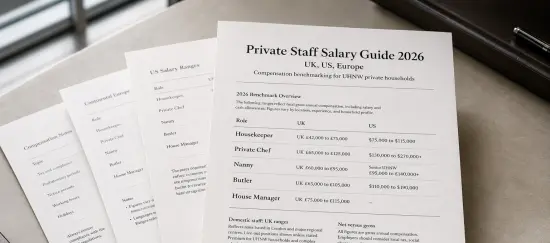
Compensation depends entirely on role, residence scale, and seniority. For full ranges see our Private Staff Salary Guide 2026.
A note on competing on price: senior household staff are paid more than published benchmarks suggest. Households that anchor on generic salary data underpay and lose strong candidates to competing households. For more on this see Why Published Salary Data Is Misleading.
Common mistakes when hiring household staff
Five patterns produce expensive household hires that do not last.
Title inflation. Calling a senior housekeeper an Executive Housekeeper, calling a butler a Head Butler when there is no team, calling a senior PA a Chief of Staff. The mismatch is visible within weeks.
Skipping the trial. Saving one to five days of paid trial work and discovering the mismatch after the candidate has signed.
Anchoring on generic salary data. Underpaying strong candidates and losing them to competing households.
Hiring without principal exposure. For senior roles, the principal interview is decisive. Skipping it produces fast departures.
Unclear authority and reporting line. The candidate accepts a role they thought they understood, then discovers six months in that the actual authority is different.
For more on common hiring mistakes see Common Hiring Mistakes in Private Offices.
How long it takes
For senior household placements, six to twelve weeks from engagement to signed offer is typical. Scoping takes one to two weeks, search and shortlisting two to four weeks, interviews and trials two to four weeks, references and offer two to three weeks. Notice periods of one to three months are standard at the senior level.
Junior placements move faster: four to six weeks is realistic. Royal and sovereign household searches take longer: four to nine months is common because the brief and the candidate pool require more careful matching.
For more on what to expect from a professional engagement see What to Expect When You Engage a Private Recruitment Firm.
How Oplu approaches household searches
We work across the full household function: junior placements through senior leadership roles. Our process is the same at every level: scoping the brief in detail, running the search through our network, interviewing every shortlisted candidate before they reach a principal, and presenting a small shortlist with full written profiles.
We are direct in scoping conversations about whether the brief will produce a good outcome. Some briefs as they arrive are not viable; we say so early rather than running a doomed search. For more on this see Why We Say No to Certain Searches.
For current vacancies see our job board. To discuss a search get in touch.
Further insights from the Oplu series