Food and beverage is where a luxury property lives or dies in the eyes of its guests. The F&B Director owns that experience. They also own the P&L behind it. Getting both right, simultaneously, is what makes this role one of the hardest leadership appointments in hospitality.
An F&B Director who cannot read a P&L will lose the owner's confidence within a quarter, regardless of how good the food is.
Oplu recruits F&B Directors for luxury hotels, private members' clubs, fine dining groups, wellness retreats and resort properties. This role sits within our Hospitality Leadership practice alongside the General Manager and Operations Director.
Why the F&B Director matters
In a luxury hotel, food and beverage can represent 30 to 50 per cent of total revenue. In a members' club, the dining experience is often the single biggest driver of member satisfaction and retention. In a fine dining group, the F&B Director is effectively the commercial leader of the entire business.
The role demands a rare combination of creative sensibility and commercial discipline. The F&B Director must understand cuisine, wine, service and guest experience at a level that earns the respect of the kitchen and front-of-house teams. They must simultaneously manage cost, margin, labour and supplier relationships at a level that satisfies the owner or board.
The best F&B Directors we see balance creativity and commercial discipline. One without the other produces either a beautiful loss-maker or a profitable bore.
What the F&B Director covers
Luxury hotels. Overseeing all food and beverage operations: restaurants, bars, room service, banqueting, events. The F&B Director reports to the General Manager and works closely with the executive chef, sommelier and front-of-house managers.
Private members' clubs. Dining is central to the members' club proposition. The F&B Director shapes the offer, manages member expectations and ensures the food and beverage experience reinforces the club's identity and exclusivity.
Fine dining groups. Where a group operates multiple restaurant concepts, the F&B Director provides strategic oversight: menu development, pricing, supplier management, concept evolution and new openings.
Wellness retreats and resorts. F&B in a wellness context has specific requirements: nutrition-led menus, dietary programming, and an approach to food that aligns with the broader wellness proposition. The F&B Director here must understand health and lifestyle trends alongside traditional hospitality.
Resorts and country house hotels. Seasonal menus, estate-sourced produce, multiple dining venues and event catering. The F&B Director manages complexity across formats and occasions.
The talent crossover with private service
There is a genuine and underappreciated crossover between commercial F&B leadership and UHNW private service. A Private Chef who has worked for a principal with multiple residences and frequent entertaining has developed skills in menu planning, dietary management, sourcing and high-pressure service that translate directly into commercial luxury F&B.
Conversely, F&B Directors sometimes move into private service, drawn by the compensation, lifestyle or the intensity of cooking for a single demanding client. Oplu sees both directions of this talent flow. Our presence in both the UHNW household and commercial hospitality markets gives us access to candidates that specialist hospitality recruiters or private service agencies alone would miss.
Comparing leadership roles
|
F&B Director |
Executive Chef |
General Manager |
| Scope |
All F&B operations, revenue and margin |
Kitchen operations, menu execution, food quality |
Full property including F&B |
| Reports to |
General Manager or group CEO |
F&B Director or General Manager |
Owner, principal or group CEO |
| Commercial ownership |
Full F&B P&L: revenue, cost, margin |
Food cost, kitchen labour |
Full property P&L |
| Creative role |
Strategic: concept, positioning, pricing |
Direct: menu creation, dish development |
Indirect: overall vision |
| Guest-facing |
Highly visible in dining rooms and bars |
Periodic, events, chef's table |
Visible across all areas |
| Team |
Restaurant managers, sommeliers, bar managers, executive chef |
Sous chefs, section chefs, kitchen porters |
All departments |
| UK salary range |
£55,000 – £110,000+ |
£45,000 – £90,000+ |
£70,000 – £150,000+ |
| US salary range |
$80,000 – $160,000+ |
$65,000 – $130,000+ |
$100,000 – $220,000+ |
The F&B Director is not a senior chef. They are a commercial leader who understands food. The distinction matters. Promoting an executive chef into an F&B Director role without assessing their commercial readiness is one of the most common and costly mistakes in luxury hospitality.
If your challenge is...
- If your food and beverage operation is well-reviewed but losing money, hire an F&B Director with strong commercial skills.
- If you need overall property leadership and F&B is one of several underperforming areas, hire a General Manager first.
- If your F&B standards are inconsistent across multiple venues or properties, hire an Operations Director to enforce consistency at portfolio level.
- If your executive chef is excellent but no one is managing the front-of-house experience, pricing or supplier costs, hire an F&B Director.
- If you are opening a new dining concept within an existing property, hire an F&B Director with pre-opening and concept development experience.
What we assess
We evaluate F&B Director candidates against the specific demands of the property and ownership context:
- Commercial fluency. Can they manage a P&L, identify margin erosion, price correctly and control cost without compromising quality? We test this directly.
- Creative credibility. Do the kitchen and front-of-house teams respect them? Can they contribute meaningfully to menu development and concept direction?
- Supplier and procurement skill. In luxury F&B, sourcing matters. The best F&B Directors have deep supplier relationships, understand provenance and can negotiate without sacrificing quality.
- Service leadership. Do they set the standard in the dining room? Are they visible during service? Do they train and develop their front-of-house team?
- Owner management. In a family-office-owned property or members' club, the F&B Director may deal directly with the principal on menu preferences, event catering and personal dining. This requires discretion and composure.
We look for F&B Directors who can walk from the kitchen to the boardroom and be credible in both. That range is rarer than most clients expect.
The difference shows up in live situations. A sommelier calls in sick two hours before a private dining event for forty. The F&B Director reassigns the wine service, briefs the replacement on the host's preferences and pairing notes, and adjusts the service plan. The host never knows. A members' club committee requests a complete menu overhaul after a single negative comment from a founding member. The F&B Director meets the committee, presents data on the fifteen most-ordered dishes, proposes targeted changes rather than a wholesale replacement, and protects both the kitchen's morale and the club's commercial margin. The member's concern is addressed. The menu improves. The committee feels heard. A new luxury hotel opens with three dining concepts. Within two months, one is underperforming. The F&B Director analyses covers, average spend and guest feedback, identifies that the concept overlaps with the main restaurant, repositions it as a casual all-day offer, and the venue finds its audience within six weeks.
Compensation
UK: Approximately £55,000 to £110,000+ depending on property type, location and portfolio scope. London and high-profile country house hotels sit at the upper end. Members' clubs with significant dining operations and fine dining groups can exceed these ranges. Benefits typically include meals on duty, bonus, private healthcare and pension.
US: Approximately $80,000 to $160,000+ with major cities and resort properties at the top of the range. Performance bonuses tied to F&B revenue and margin targets are standard. Total compensation can increase significantly with bonus in high-revenue operations.
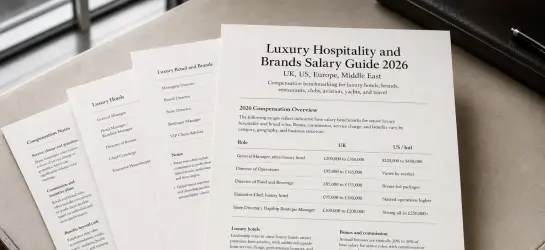
Ranges for Food & Beverage Director and comparable positions are set out in the Luxury Hospitality and Brands Salary Guide. We share benchmarks for your specific brief once the search is scoped.
What you receive
- A scoped brief with clear responsibilities, coverage, reporting line and boundaries
- A discreet search with controlled disclosure and direct outreach
- A deliberately small shortlist built for comparison and decision-making
- Written profiles covering role-fit, working pattern, compensation expectations and notice period
- Referencing where possible, staged to protect privacy
- Offer support and transition planning to reduce churn
How we work
- Scoping – We define the F&B operation, its commercial targets, the reporting structure and the specific profile needed. We clarify the balance between creative and commercial, and the level of owner or principal involvement in F&B decisions.
- Mapping – We identify candidates across luxury hotels, members' clubs, fine dining groups and private service. The crossover between commercial F&B and Private Chef placements gives us a broader view of the talent market.
- Outreach – Direct, confidential approaches. No advertising unless requested.
- Shortlist – A focused shortlist with detailed written profiles covering role-fit, commercial capability and cultural alignment.
- Selection support – Interview coordination, feedback management and communication throughout.
- Offer and transition – Offer structuring, negotiation and transition planning.
What candidates at this level look for
The strongest F&B Directors are not motivated by title alone. They are evaluating the operation, the ownership, and whether they will be allowed to do the job properly.
Creative freedom is paramount. An F&B Director who is told what the menu should look like, which suppliers to use, and how the dining room should feel is not an F&B Director. They are an executor. The best candidates want a clear commercial brief and the latitude to deliver against it with their own judgement. If the owner or GM intends to make every F&B decision personally, the strongest candidates will decline.
They assess the kitchen. Before accepting, a serious F&B Director will want to understand the executive chef's capability, the kitchen's condition, and the investment available for equipment and renovation. Inheriting a dysfunctional kitchen with no budget to fix it is a known trap.
Brand and reputation matter. Senior F&B leaders want to work in properties that enhance their professional standing. A venue with a strong reputation attracts candidates who want to build on it. A venue with a damaged reputation attracts candidates who want the challenge, but only if the owner is willing to invest in the turnaround.
They watch how the interview process is run. If the owner changes the brief, contradicts the GM, or treats the F&B role as secondary to rooms division, candidates notice. The best F&B Directors know their value. They choose environments where food and beverage is treated as central to the guest experience, not as a cost centre to be minimised.
Further reading
Next steps
If you are hiring an F&B Director for a luxury hotel, members' club, restaurant group or resort, contact Oplu for an initial conversation. We will help you define the brief, understand the market and identify candidates who combine creative credibility with commercial discipline.