The CEO of a luxury brand carries a dual mandate. Grow the business. Protect the brand. These two objectives sit in permanent tension, and the leader who gets the balance wrong in either direction will damage the company.
Oplu recruits CEOs and Managing Directors for luxury brands, concierge firms, ultra-high-end property management companies, lifestyle management businesses and premium consumer brands. These are senior appointments where the hire shapes not just commercial performance but brand positioning, team culture and the relationship with investors or founders.
A CEO for a luxury brand must protect the brand's positioning as fiercely as they pursue growth. Scaling without discipline is how premium brands become ordinary.
Why this role matters
In a luxury brand with twenty to fifty people, the CEO touches everything. Product decisions, pricing, key client relationships, partnership approvals, team composition. There is no layer of middle management to absorb a wrong call. The CEO is the brand's last line of defence and its primary engine for growth.
The stakes are higher still when the brand is backed by a family office or private investor. The CEO answers to a principal, not a committee. The relationship is direct, the expectations are personal, and the consequences of misalignment are immediate.
When a family office invests in a luxury brand, the CEO answers to a principal, not a board. The politics are personal. We scope governance and reporting before searching.
The CEO hired by a founder vs hired by an investor
Not all CEO mandates are the same. The brief looks fundamentally different depending on who is hiring.
Founder-appointed CEO. The founder built the brand and now needs a leader to run the business while they step into a creative, ambassadorial or board-level role. The CEO must respect the founder's vision while bringing operational and commercial rigour. This is a relationship hire as much as a competence hire.
Investor or family office-appointed CEO. A principal or investment vehicle has acquired or invested in the brand and needs someone to professionalise operations, hit growth targets and report back clearly. The CEO must understand principal dynamics, manage upward effectively and deliver against commercial KPIs without eroding brand value.
Oplu scopes the governance structure and reporting line before searching. The candidate profile changes significantly depending on which mandate applies.
The founder who built the brand and the CEO who scales it are rarely the same person. Managing that transition without damaging the brand requires a hire who understands both the vision and the commercial reality.
Founder-to-CEO transition
One of the most common briefs in this category is the founder-to-CEO transition. The brand has outgrown the founder's operational capacity. Revenue is growing, the team is expanding, and the founder's strengths in product and brand building are no longer sufficient for the complexity of the business.
This transition is sensitive. The founder is emotionally invested. The team's loyalty is often personal. The new CEO must earn trust without displacing the culture that made the brand successful.
We handle these briefs with particular care. We scope the founder's ongoing role, their appetite for operational involvement, and the boundaries between creative leadership and business management before presenting candidates.
Comparing senior leadership roles in luxury brands
| Dimension |
CEO / Managing Director |
COO |
CMO / Marketing Director |
| Core focus |
Overall strategy, P&L, stakeholder management |
Operational delivery, process, supply chain |
Brand positioning, marketing, growth |
| Accountability |
Full business performance |
Operational efficiency and quality |
Brand equity and revenue from marketing |
| Relationship to brand |
Guardian and commercial steward |
Enabler of brand delivery |
Architect of brand perception |
| Reports to |
Board, founder or principal |
CEO |
CEO or founder |
| Key risk if wrong hire |
Strategic drift or brand dilution |
Operational breakdown, quality failures |
Brand erosion or market irrelevance |
| Typical prior role |
MD, CEO or senior GM in luxury or premium |
Operations Director, COO in luxury or hospitality |
Marketing Director, VP Marketing in luxury |
If your challenge is...
- If the brand needs a single leader accountable for strategy, P&L and stakeholder relationships, hire a CEO / Managing Director.
- If the business runs well commercially but the brand is losing relevance or positioning, hire a CMO / Marketing Director.
- If the founder is stepping back and the business needs someone to professionalise operations without losing the brand's identity, hire a CEO / Managing Director with founder-transition experience.
- If the brand also owns or operates hospitality assets and needs an on-site leader, hire a General Manager for the property and a CEO for the brand. These are separate roles.
- If your operational delivery is failing but the brand and strategy are sound, consider a COO before defaulting to a CEO search.
What we look for
The right CEO for a luxury brand combines commercial capability with brand sensitivity. Specific attributes we assess include:
Brand custodianship. The ability to make growth decisions that respect and reinforce the brand's positioning. This means saying no to opportunities that would dilute exclusivity.
Principal management. Experience reporting to founders, family office principals or private investors. Understanding the personal dynamics of these relationships.
Team leadership at scale. Building and leading small, high-performing teams where every hire matters. Luxury brands do not have the margin for passengers.
Commercial fluency. P&L ownership, revenue strategy, pricing discipline and the ability to articulate commercial performance to investors without reducing the brand to a spreadsheet.
Transition sensitivity. For founder-transition briefs, the emotional intelligence to respect what came before while building what comes next.
These qualities surface in real situations. A family office acquires a premium wellness brand and installs a new CEO. Within three months, the founder publicly distances herself from the new direction. The CEO requests a private meeting, listens to the founder's concerns, adjusts the rollout timeline for two product lines, and co-presents the revised plan to the board. The founder re-engages. The brand avoids a public rupture. A luxury concierge firm loses its two largest accounts in the same quarter after a service failure. The CEO personally visits both clients, acknowledges the failure without deflection, presents a remediation plan with specific timelines, and retains both accounts on revised terms. Revenue stabilises within sixty days. A premium fashion brand's direct-to-consumer channel is cannibalising its wholesale partners. The CEO restructures the pricing architecture, introduces exclusive wholesale-only lines, and rebuilds the partner relationships over two quarters. Neither channel is sacrificed.
Compensation
UK salaries for CEO and Managing Director roles in luxury brands typically range from approximately £80,000 to £180,000 or above, depending on brand size, revenue and equity structure. Roles in larger or internationally operating brands sit at the upper end. Equity participation and performance bonuses are common, particularly in investor-backed businesses.
US compensation typically ranges from approximately $120,000 to $280,000 or above in base salary. Total compensation with equity, bonus and profit-share arrangements can exceed $400,000 for established brands with significant revenue.
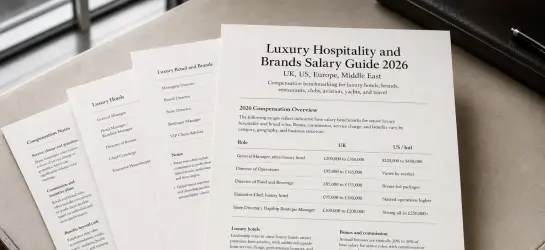
Ranges for CEO and comparable positions are set out in the Luxury Hospitality and Brands Salary Guide. We share benchmarks for your specific brief once the search is scoped.
What you receive
- A scoped brief with clear responsibilities, coverage, reporting line and boundaries
- A discreet search with controlled disclosure and direct outreach
- A deliberately small shortlist built for comparison and decision-making
- Written profiles covering role-fit, working pattern, compensation expectations and notice period
- Referencing where possible, staged to protect privacy
- Offer support and transition planning to reduce churn
What candidates at this level look for
CEO and Managing Director candidates in the luxury sector are assessing the opportunity with the same rigour they would apply to any investment. The best ones are not desperate. They are selective.
The principal relationship is the deciding factor. Experienced luxury brand CEOs want to know whether the founder or investor will respect their commercial expertise or override every decision. They ask about governance, decision rights and how disagreements were handled with the previous leader. If the answer is vague, they assume the worst. A principal who cannot delegate commercial authority will not attract a CEO capable of exercising it.
Brand quality is personal. These candidates have spent careers building reputations in premium markets. They will not attach their name to a brand they do not believe in. They assess the product, the positioning, and whether the investment exists to maintain both. A brand that looks premium from the outside but cuts corners internally will be exposed during due diligence.
They evaluate the team they will inherit. A CEO who arrives to find that every competent person has already left faces a rebuild, not a leadership transition. Candidates ask about retention, about who stayed and who left, and why.
Compensation is important but secondary to mandate. The strongest candidates will accept a lower base for genuine equity and autonomy. They will reject a higher base if the role is ceremonial or the principal retains all real authority. The structure of the offer reveals the structure of the relationship.
Related roles
Further reading