Finding the right household couple is one of the more nuanced hires in private service. Oplu specialises in household couple recruitment for principals and families who need reliable, complementary coverage across a property or estate. The role demands two people who work as one unit, each bringing distinct skills and the temperament to live and work in close proximity to a principal's private life.
A household couple is not two separate hires sharing a cottage. It is a single unit with complementary skills. The best couples divide responsibilities clearly. The worst duplicate effort and create confusion. Getting this right from the outset determines whether the arrangement lasts months or years.
Household couple recruitment agency
Oplu is a private household recruitment agency working with principals, family offices and estate managers across the UK, US and internationally. We place household couples into country estates, city residences, holiday properties and multi-site portfolios. Our approach is built on scoping the brief properly before search begins, assessing couples as a unit and as individuals, and presenting only candidates who fit the property and the principal.
Related roles
When to hire a Household Couple
A household couple suits a property that needs consistent, resident coverage but does not justify a full team. Common scenarios include:
- Country estates with a single principal or small family. The property needs daily housekeeping, cooking, garden oversight, driving and maintenance. Two people with the right skill split can cover all of it.
- Secondary or holiday homes. Properties used seasonally still need year-round care. A resident couple maintains the house, manages contractors and ensures readiness at short notice.
- Downsized households. A principal moving from a staffed estate to a smaller property may replace a team of four or five with a capable couple.
- International properties. Villas, chalets and island homes where local staffing is unreliable. A trusted couple who relocates permanently solves a logistics problem.
If the property needs someone present most of the time and the workload spans more than one discipline, a couple is worth considering.
Household Couple vs separate Housekeeper and Butler
| Option |
Coverage |
Cost |
Key consideration |
| Household Couple |
Broad, flexible coverage across housekeeping, cooking, maintenance, driving and service. Resident on-site. |
Lower total cost. One accommodation, one recruitment process, one management relationship. |
Both must be strong individually. A weak link undermines the whole arrangement. |
| Separate Housekeeper + Butler |
Specialist coverage in each discipline. Formal service standard. |
Higher total cost. Two salaries, potentially two accommodations, two management relationships. |
Suits larger or more formal households where the volume of work justifies dedicated roles. |
| Live-in Single Housekeeper |
Core housekeeping and light cooking. One person, resident on-site. |
Lowest cost. Single salary and accommodation. |
Limited scope. No cover for maintenance, driving or formal service. Burnout risk if the brief creeps. |
The couple model works best when the property needs breadth rather than depth. If the household requires highly formal service or a housekeeper managing a large team, separate hires are more effective.
If your household needs...
- Broad, flexible coverage across housekeeping, cooking, maintenance and driving on a single estate, hire a Household Couple.
- Specialist housekeeping with no property maintenance or driving, hire a dedicated Housekeeper.
- Formal front-of-house service and principal-facing duties, hire a Butler.
- A secondary or holiday property that needs year-round resident care with minimal principal contact, a couple is almost always the right model.
- A large estate with regular entertaining and a team of staff already in place, separate specialist hires will outperform a couple arrangement.
Core responsibilities and day-to-day scope
The exact split depends on the couple and the property. A typical division might look like this:
One partner (often the housekeeper role):
- Daily housekeeping, laundry and wardrobe care
- Cooking from everyday meals to informal entertaining
- Table setting and service for smaller dinners
- Household inventory, supplies and deliveries
- Liaising with external cleaning teams for deep cleans
The other partner (often the property and service role):
- Property maintenance, minor repairs and contractor oversight
- Garden upkeep or management alongside external teams
- Driving, airport runs and errands
- Security awareness, locking up, alarm systems
- Formal service duties where required
- Vehicle care and fleet management
In practice, the lines blur. A good couple is flexible. But the brief should define who owns what. Ambiguity about responsibilities is one of the fastest routes to resentment and turnover.
What great looks like in practice
The best household couples share certain qualities:
- Self-managing. They do not need daily direction. They anticipate what the property and the principal need.
- Discreet. Living on-site means proximity to private family life. Boundaries are respected without prompting.
- Complementary, not overlapping. Each partner has a clear strength. They do not compete for the same tasks.
- Resilient under pressure. When the principal arrives with twelve guests at short notice, the couple adapts without drama.
- Aligned on lifestyle. Both are comfortable with the live-in arrangement, the location and the hours. If one is unhappy, both leave.
The principal calls on Wednesday to say the family will arrive at the Cotswolds estate on Friday for the weekend with six guests. The couple has the house open, heated, stocked and guest-ready by Thursday evening. One partner prepares the bedrooms and kitchen. The other checks the grounds, clears the drive, and ensures the hot tub is serviced. By the time the family arrives, the estate looks as though it has been staffed all week.
A pipe bursts in the utility room at 11pm on a January night. One partner isolates the water supply and contacts the emergency plumber. The other moves affected linens and protects the floor. By morning, the repair is underway and the principal, who is at the London residence, receives a brief update by text. No drama. No escalation needed.
The principal's elderly mother visits for a fortnight. The couple adjusts meals to her preferences, ensures the ground-floor guest suite is set up for comfort and mobility, and drives her to local appointments. The principal later says it was the most relaxed visit in years.
We assess couples as a unit and individually. A strong housekeeper married to a weak gardener is not a strong couple. Both must stand on their own merit. This is a non-negotiable part of how Oplu evaluates candidates.
Compensation and package guidance
Compensation for household couples varies by location, property complexity, number of residences and the skill set required.
United Kingdom:
- Standard roles: £50,000 to £80,000 combined per annum
- Experienced couples managing complex estates: £80,000 to £120,000+ combined per annum
- Accommodation is typically included, often a separate cottage or flat on the estate
United States:
- Standard roles: $65,000 to $110,000 combined per annum
- Senior couples managing larger properties: $110,000 to $160,000+ combined per annum
- Accommodation is usually included
Additional benefits commonly include a vehicle allowance, meals on duty, health cover and pension contributions. Holiday cover should be agreed at offer stage.
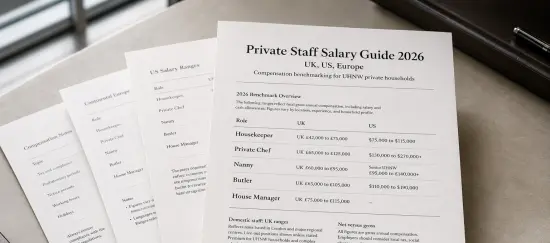
Ranges for Domestic Couple and comparable positions are set out in the Private Staff Salary Guide. We share benchmarks for your specific brief once the search is scoped.
Common hiring mistakes (and how to avoid them)
Hiring on charm alone. Couples who interview beautifully do not always perform under sustained pressure. Practical assessments and thorough referencing matter more than polished conversation.
Ignoring the accommodation. Live-in couples work well when accommodation is genuinely private and off-duty boundaries are respected. When the cottage is next to the kitchen and the lights are always on, retention drops fast.
Treating one partner as a bonus. Some principals hire for one role and assume the partner will fill gaps. Both need a defined role, agreed hours and fair compensation.
Skipping individual assessment. Interviewing only as a couple hides individual weaknesses. Speak to each person separately. Test practical skills independently.
Overloading the brief. A couple can cover a lot of ground, but they cannot replace a team of five. Overloading is the most common cause of early departure.
What candidates at this level look for
Household couples are motivated by stability, quality of accommodation and the opportunity to build a long-term life on a well-run estate. The best couples have worked together for years and take genuine satisfaction in maintaining a property to a high standard. They value autonomy, a clear brief and a principal who trusts them to manage the day-to-day without constant oversight.
They leave when accommodation is inadequate or when boundaries between work and private life collapse. A cottage with thin walls next to the main house, no separate entrance, or an expectation that they are always available creates burnout quickly. They also leave when one partner's contribution is undervalued, when the workload expands beyond what two people can reasonably manage, or when promised time off is routinely cancelled.
During interviews, strong couples assess the accommodation first. They want to see the cottage or flat, understand the off-duty arrangements, and know whether the principal will respect their private time. They ask about the property's maintenance history, the entertaining frequency, and whether additional staff are brought in for busy periods. They also want to understand the notice period and what happens if they decide to leave.
Red flags include accommodation that is clearly not designed for long-term living, a brief that lists responsibilities for four people but offers two salaries, and a principal who has never employed a couple before and has unrealistic expectations about coverage. The best couples have seen these patterns before and will walk away from them.
How Oplu hires Household Couple
Oplu runs a structured search for every household couple placement. We begin with a detailed brief covering the property, the skill split, the accommodation and the reporting line. From there, we search discreetly through our network and direct outreach.
What you receive:
- A scoped brief with clear responsibilities, coverage, reporting line and boundaries
- A discreet search with controlled disclosure and direct outreach
- A deliberately small shortlist built for comparison and decision-making
- Written profiles covering role-fit, working pattern, compensation expectations and notice period
- Referencing where possible, staged to protect privacy
- Offer support and transition planning to reduce churn
- Trial design support for hands-on roles or practical assessments
We present couples only when both individuals meet the standard. If one partner is strong and the other is not, we say so.
Next steps
- Hiring now: Share a brief and we will confirm scope, coverage and the right level before search.
- Shortlist: Expect a small, decision-ready shortlist with role-fit and expectations aligned.
- Related roles: Explore Housekeeper, Estate Manager.
- Candidates: Explore current opportunities on our job board.
Further reading