A governess or governor is one of the most deliberate hires a principal can make. Unlike other household roles, the appointment is not about logistics or comfort. It is about the intellectual and social formation of a child. The person you hire will shape how your children read, reason, argue and present themselves. In a private household with specific academic expectations, cultural traditions or international commitments, that responsibility demands more than teaching ability. It demands discretion, adaptability and an instinct for the particular standards of the family.
Oplu is a governess recruitment agency working exclusively with UHNW principals, private estates and family offices. We source candidates who have operated at the highest level of private education: holders of QTS, PGCE and strong academic degrees from leading universities, with verifiable experience in private households where expectations were non-negotiable.
Governess and Governor Recruitment: Related Roles
If you are building a childcare team or considering alternatives, the following roles may also be relevant to your household:
When Is a Governess or Governor the Right Hire?
The governess or governor model suits households where academic rigour, structured progression and social formation are priorities, and where the conventional school system either cannot deliver them or is supplementing a private education that demands more.
Common situations include:
- Children being educated primarily or partly at home, either by parental choice or because the family's travel schedule makes consistent school attendance impractical
- Pupils attending school who require structured academic reinforcement, enrichment beyond the curriculum, or preparation for highly selective entry examinations (Common Entrance, 13+, scholarship papers)
- Families with a specific educational philosophy (classical, Montessori-inflected, language-immersive) that standard schooling does not support
- Households where a second or third language is a non-negotiable developmental goal
- Principals who want a single, accountable point of contact for their child's intellectual development rather than a rotation of tutors
Where a nanny manages the child's day and a tutor addresses a single subject, a governess or governor owns the whole educational picture. That breadth is both the role's defining value and the reason the hire requires particular care.
Governess vs Nanny vs Tutor: Key Differences
These three roles are frequently confused. The distinctions matter because placing the wrong person in the role produces results that satisfy none of the family's actual goals.
Governess / Governor: Responsible for the child's structured academic programme across multiple subjects, social development, manners, cultural formation and, often, language acquisition. Typically degree-educated and teaching-qualified. The role is educational in origin, pastoral in practice.
Nanny: Responsible for the child's physical care, emotional security, routine and general welfare. An excellent nanny may support learning through play and conversation, but is not expected to deliver a structured academic programme. The role is pastoral first, with an educational dimension that varies by candidate.
Tutor: Engaged for a specific subject, examination or developmental goal. Works in defined sessions. Has no ongoing oversight of the child's broader education or day-to-day experience.
In many private households, a governess and a nanny work alongside each other, with clearly divided responsibilities. Some principals seek a hybrid candidate who can perform both functions. These individuals exist, but the pool is narrower and the compensation is higher. Oplu advises on which model fits each household before a brief is written.
Responsibilities and Outcomes in a Private Household
The governess or governor's core responsibilities in a private household typically include:
- Designing and delivering a structured daily curriculum, calibrated to the child's age, ability and specific academic targets
- Teaching core subjects, including mathematics, English language and literature, history, and science
- Overseeing second-language instruction or delivering it directly where the candidate is a native or near-native speaker
- Managing relationships with any external tutors, subject specialists or school staff
- Preparing pupils for entrance examinations, scholarship assessments or standardised testing
- Supervising cultural and enrichment activities: museum visits, concerts, reading lists, debate practice
- Reporting to parents on academic progress, with written assessments where required
- Travelling with the family when required, maintaining programme continuity across residences
In a household with younger children (three to seven), the focus is on foundational literacy, numeracy and developing curiosity. In the seven to thirteen range, the emphasis shifts toward structured subject delivery, examination readiness and the development of independent study habits. A governess working with a teenager may take on a more mentoring quality, supporting university preparation alongside subject teaching.
What to Look For: Qualifications, Approach and Temperament
A strong governess or governor candidate will hold a degree from a respected university, ideally in a relevant subject, and carry a teaching qualification such as a PGCE or QTS. Candidates who trained in the UK independent or grammar school sector often bring a more appropriate academic standard than those from mainstream state primary backgrounds, though this is not a universal rule.
Beyond credentials, the practical markers of quality include:
- A structured approach to lesson planning, with the flexibility to abandon a plan when a child's needs on a given day require it
- The ability to maintain authority without rigidity: children in private households are often confident, socially precocious and unused to being corrected. A good governess sets standards without antagonising the child or unsettling the parents
- Discretion that is instinctive rather than performed: the candidate understands that information about the family, the household and the children does not leave the house
- Experience of travel and adaptation across multiple residences and time zones
- A manner that is warm without being sycophantic: the relationship with the principal and their children requires composure and self-possession
Fluency in a second language that the family values is a significant differentiator. A governess who can deliver French or Mandarin as a working language of daily instruction brings measurable value that a monolingual candidate cannot match.
What Great Looks Like: Scenarios
A governess working with a six-year-old and a nine-year-old in a household that splits time between London, the south of France and a ski chalet manages two parallel educational programmes while maintaining pace with each child's school curriculum during term time. She communicates weekly with each child's class teacher, adjusts the programme after school breaks to account for regression, and transitions the household's educational schedule between residences without prompting.
At senior level, a governor working with a fourteen-year-old preparing for GCSE scholarship papers at a competitive boarding school delivers a six-subject programme, identifies gaps the school has not addressed, and coordinates with external subject specialists for chemistry and Latin. He tracks progress against mark schemes, runs mock examinations and provides the family with a written report each half-term.
Compensation and Package Guidance
United Kingdom
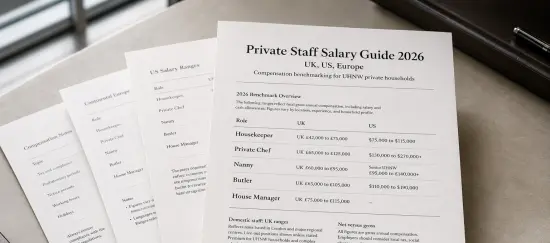
Market rates for experienced governesses in London and the home counties range from £50,000 to £80,000 gross per annum for live-out positions. At Oplu's placement tier, reflecting UHNW household standards and the expectation of travel, bilingual ability and senior academic credentials, expect to budget from £55,000 to £88,000 gross per annum for live-out candidates, and £45,000 to £70,000 gross (plus accommodation and full benefits) for live-in arrangements. Rota arrangements carry a meaningful premium above the live-in rate.
Standard package components at this level include: private medical insurance, pension contributions, a dedicated device for educational administration, and a travel and expenses allowance. Some households also cover professional development costs, including further language training.
United States
In New York, Los Angeles and comparable markets, annual compensation for a private governess or governor in a UHNW household ranges from $85,000 to $155,000 gross per annum, depending on qualifications, subject depth and language profile. Top-of-market candidates with advanced degrees and multilingual ability, engaged in sole-charge academic arrangements, can command $165,000 or above. Benefits typically include health insurance, accommodation or housing allowance, and a 401(k) contribution.
Common Hiring Mistakes
Hiring a tutor and calling them a governess. The two roles have different scopes, different authority and different expectations. Engaging a single-subject specialist and expecting them to own the child's entire educational programme produces frustration on both sides.
Prioritising academic credentials over household fit. A candidate with a first-class degree and a PGCE who has never worked in a private household may struggle with the pace, the informality of authority, and the requirement to subordinate their professional instincts to the preferences of the principal. Previous private household experience, properly verified, is not optional at this level.
Underestimating the bilingual premium. If language acquisition is a household goal, a governess who does not speak the target language cannot deliver it, regardless of their other qualities. Resist the temptation to hire a strong monolingual candidate with the intention of bolstering language through separate lessons.
Delaying the search. Governess recruitment at the senior level typically takes six to ten weeks from brief to placement, longer when a very specific language or academic profile is required. Starting the process too late compresses assessment time and increases the likelihood of a hire that was made under pressure rather than on merit.
What Candidates at This Level Are Looking For
Exceptional governesses and governors are not passive in their job search. They are in demand, and they select households with as much care as the principal selects them. Candidates at the top of the market are looking for:
- Clear educational briefs: a household that knows what it wants the child to achieve and can articulate it
- Professional respect: recognition that they are educators, not childcare staff
- Stable working conditions: clarity about travel requirements, working hours and the scope of the role before they accept
- A principal who is engaged with the child's progress without micromanaging the delivery
- Confidentiality and professionalism in the recruitment process itself
Oplu briefs candidates thoroughly before any introduction. Candidates who meet our clients know what the role is, what the family expects and why the engagement is worth their consideration.
How Oplu Sources, Vets and Shortlists Candidates
Oplu does not advertise widely or rely on job board applications. Our governess recruitment process draws on a maintained network of credentialled educators with verified private household experience, supplemented by targeted outreach where a specific academic or language profile is required.
Every candidate presented to a client has been through the following before any introduction:
- Structured interview covering educational philosophy, household experience, approach to authority and discretion
- Academic and professional credential verification
- A minimum of two substantive references from private household principals, not from schools or agencies alone
- Background and DBS/CRB checks to the standard required for sole-charge child supervision
- Assessment of travel readiness and adaptability where the role involves multiple residences
We shortlist to a small number of candidates per brief, typically three, each presented with a detailed written profile. We do not send volumes of applications. We present considered recommendations.
Next Steps
If you are ready to begin a governess or governor search, contact Oplu directly. We will schedule a call to discuss your household, your children's current educational stage and your objectives. From that conversation, we will determine whether a governess, a hybrid candidate or a combination of roles is the right structure, and we will build the brief accordingly.
If you are not yet ready to engage and want to understand the market in more detail, visit our Childcare and Education hub for guidance across the full range of roles.
Further Reading