A butler sets the tone for a household. They ensure that daily life runs quietly, consistently and to a standard that rarely needs explaining twice. In private households, this is not a ceremonial role. It is operational, personal and often invisible when done well.
Oplu places butlers in UHNW households, family offices and private estates across the UK, US and internationally. Our search process is built around discretion, reference depth and role-fit. The difference between a good butler and the wrong butler is felt immediately, and it is rarely about technical skill alone. It is about temperament, judgement and an instinct for what a household needs before it is asked.
Butler recruitment agency
Butler recruitment in private households requires more than matching a CV to a job description. The role varies enormously. A single principal in a London townhouse needs something very different from a family with multiple residences, frequent travel and a large support team.
Oplu structures every search around the household, not a generic role template. We define the scope, reporting line, living arrangements and coverage expectations before outreach begins. Strong candidates ask detailed questions. If the brief is vague, the best people do not engage.
Related roles
When to hire a Butler
Not every household needs a butler. The role makes sense when the principal wants one person to own service standards, guest-facing duties and the smooth running of the interior household. Common triggers include:
- The principal entertains regularly and expects a high, consistent standard of service
- The housekeeper or house manager is stretched beyond their natural scope
- A travelling household needs a single point of accountability for personal service on the move
- A new residence requires routines, suppliers and household protocols established from scratch
- Multiple staff are in place but nobody is coordinating the service layer
If the household already has a strong house manager and a reliable housekeeper, a butler adds a layer of formality and personal service that those roles do not naturally cover.
Butler vs Housekeeper vs House Manager
These three roles are frequently confused. The overlap causes problems when the brief is not clear.
| Role |
Focus |
Typical mandate |
Key difference |
| Butler |
Personal service and front-of-house |
Guest service, table service, valeting, wine management, coordinating service staff |
The face of the household. Focused on how things feel. |
| Housekeeper |
Cleanliness, order and domestic operations |
Cleaning schedules, laundry, linen, supplies, supervising cleaning staff |
Keeps the house running behind the scenes. Focused on standards. |
| House Manager |
Administration and staff coordination |
Budgets, scheduling, vendor management, maintenance oversight, HR |
Manages the business of the household. Focused on systems. |
In larger households, all three roles work alongside each other. In smaller households, one person may cover two of these functions. The brief must be honest about which combination is needed.
If your household needs...
- A principal-facing service professional who owns entertaining, valeting and guest management, hire a Butler.
- Hands-on domestic standards without formal front-of-house service, hire a Housekeeper.
- Someone to run the household as a business, managing staff, budgets and vendors, hire a House Manager.
- A single hire who combines butler and house management in a smaller household, scope a butler-manager role. We help define the boundary.
- A resident pair covering both service and property maintenance, hire a Household Couple.
Core responsibilities and day-to-day scope
A butler's responsibilities vary by household, but the core typically includes:
- Personal service. Wardrobe management, valeting, packing for travel and anticipating daily needs.
- Guest and entertaining management. Setting tables, managing service during dinners and events, greeting guests and maintaining hospitality standards.
- Wine and cellar management. Maintaining the cellar, advising on pairings and managing stock.
- Front-of-house coordination. Overseeing service staff, briefing temporary staff and ensuring consistency.
- Household errands and logistics. Managing deliveries, coordinating with suppliers, handling reservations and personal requests.
- Travel support. Packing, advance preparation of residences and accompanying the principal on trips where required.
For travelling positions, the candidate is available around the clock for the duration. Define overtime rules before the search, not after the first trip. This detail causes friction if left unaddressed.
What great looks like in practice
The best butlers share qualities that go beyond formal training. They are composed under pressure, observant without being intrusive, and able to adjust depending on whether the household is hosting twenty guests or the principal is spending a quiet weekend alone.
Great butlers anticipate. They notice when a guest's glass is low, when the temperature in a room has shifted, when a routine has changed. They do not wait for instructions on things that should not need them.
A guest spills red wine on a silk cushion during a drinks reception. The butler removes it, replaces it, and has the stain treated within minutes. Nobody notices.
The principal decides at 5pm to host a private dinner for eight at 8pm. The butler confirms the menu with the chef, sets the dining room, briefs temporary service staff, selects wines, and greets the first guest at the door. The principal arrives downstairs to a room that looks as though it was planned for a week.
A visiting head of state's protection team requests a room sweep thirty minutes before arrival. The butler coordinates access, adjusts the service plan and ensures the household staff are briefed and positioned without creating visible disruption.
For roles with close personal access, such as a butler to a female principal, there is often a gender preference. This is the nature of private household work, not a policy issue. The butler operates in intimate spaces and the principal must feel entirely comfortable.
Discretion is non-negotiable. The best candidates treat everything they see and hear as confidential without being told. This is instinct, not training.
Compensation and package guidance
Butler salaries vary depending on location, household complexity, travel demands and seniority.
United Kingdom
- Standard butler roles: GBP 35,000 to GBP 60,000
- Senior butlers in complex or multi-residence households: GBP 60,000 to GBP 90,000+
United States
- Standard butler roles: USD 50,000 to USD 90,000
- Senior or travelling butlers: USD 90,000 to USD 140,000+
- New York and California benchmark highest
In private work, the starting salary is rarely the whole story. Bonuses for travel, seasonal support and exceptional service are common and can significantly increase total compensation. Packages often include accommodation, meals on duty, private medical insurance and a discretionary annual bonus.
Some clients prefer to start staff on a lower salary deliberately. Not low, but below what they could pay. A high number attracts candidates motivated by money. A reasonable number attracts candidates motivated by the role. The salary rises fast for the right person.
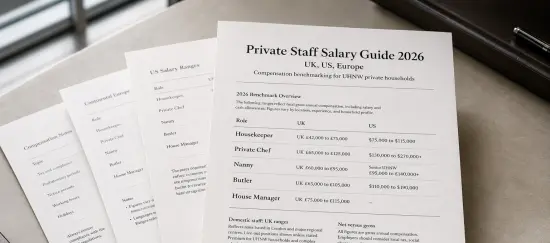
Ranges for Butler and comparable positions are set out in the Private Staff Salary Guide. We share benchmarks for your specific brief once the search is scoped.
Common hiring mistakes (and how to avoid them)
Hiring on formality alone. A candidate with impeccable silver service training may not suit a relaxed household. Match the person to the household culture, not a textbook.
Skipping the trial. Butlers work in close proximity to the principal. A paid working trial of one to two weeks reveals far more than any interview.
Undefined boundaries. If the butler is also expected to drive, manage the house and walk the dogs, say so. Ambiguity leads to resentment and early turnover.
Ignoring the team dynamic. A butler who cannot work alongside a housekeeper or chef will cause problems regardless of individual quality. Ask about collaboration in references, not just competence.
Rushing the search. Candidates in good positions do not move quickly without a compelling reason. Allow four to eight weeks for a thorough search.
What candidates at this level look for
Experienced butlers are drawn to households where service is valued, not just expected. They want a principal who understands the role, respects the craft and allows them the autonomy to set and maintain standards. The best butlers take genuine pride in running a flawless household. What motivates them is not the salary alone but the opportunity to work at the highest level with a principal who appreciates what they do.
They leave when the role becomes undefined. A butler hired for formal service who is then asked to walk dogs, run errands and cover housekeeping gaps will not stay. They also leave when the principal micromanages service decisions, when promises about accommodation or rest days are not honoured, or when the household culture treats staff poorly.
During interviews, strong candidates assess the principal's communication style, the clarity of the reporting line, the quality of staff accommodation and the household's attitude toward service. They ask about the entertaining calendar, the other staff in place, and how the previous butler departed. They notice whether the household is organised or chaotic when they arrive.
Red flags in a brief include an unrealistic scope that combines butler, housekeeper and house manager into one role at a single salary. Vague hours, no mention of live-in arrangements, and a pattern of short tenures signal problems that experienced candidates will not overlook.
How Oplu hires Butlers
Every placement begins with a detailed brief and ends with transition support.
What you receive:
- A scoped brief with clear responsibilities, coverage, reporting line and boundaries
- A discreet search with controlled disclosure and direct outreach
- A deliberately small shortlist built for comparison and decision-making
- Written profiles covering role-fit, working pattern, compensation expectations and notice period
- Referencing where possible, staged to protect privacy
- Offer support and transition planning to reduce churn
- Trial design support for hands-on roles or practical assessments
Next steps
- Hiring now: Share a brief and we will confirm scope, coverage and the right level before search.
- Shortlist: Expect a small, decision-ready shortlist with role-fit and expectations aligned.
- Related roles: Explore Housekeeper, House Manager.
- Candidates: Explore current opportunities on our job board.
Further reading