A Management Couple is a pair, typically married or in a long-term partnership, who together oversee the operations, staff and service delivery of a private estate or residence. They are not two people doing the housework. They are two people running the household. This distinction matters profoundly, and misunderstanding it is one of the most common errors in private estate recruitment.
One partner typically takes responsibility for interior operations (housekeeping, service, guest management), while the other focuses on exterior operations (grounds, maintenance, property management). Together, they offer the principal a complete management solution, living on site and deeply invested in the estate's success.
Oplu recruits Management Couples for private estates and UHNW residences internationally. We assess both the professional capabilities of each partner and the strength of the partnership itself.
Management couple recruitment agency
Oplu is a specialist recruitment agency for private households and estates, with particular experience in placing Management Couples in country estates, overseas villas and ski chalets. Our consultants assess each partner individually and as a team, ensuring skills and standards align with the principal's requirements.
Related roles
What is a Management Couple?
A Management Couple oversees and directs the running of a private estate. They manage other staff, coordinate contractors, maintain standards and ensure that the property is ready for the principal at all times. Their role is supervisory and managerial, not hands-on domestic work.
This is the critical distinction. A Management Couple manages. A Domestic Couple does.
A Domestic Couple might consist of a housekeeper and a handyman/driver, or a cook and a gardener. They perform the physical work of maintaining the household themselves. They are valued and essential, but they are not managers.
A Management Couple recruits, trains and supervises the staff who do that work. They manage budgets, liaise with contractors, plan events and report to the principal or family office. They may step in during busy periods, but their primary function is leadership and oversight.
Principals who hire a Management Couple expecting them to do all the housework, cooking and gardening themselves will be disappointed. Principals who hire a Domestic Couple expecting them to manage a team of ten will be equally disappointed. The distinction must be clear from the outset.
When to hire a Management Couple
The estate needs on-site management but not a full management team. A medium-sized country estate with four to eight staff does not always justify separate Estate Manager, House Manager and Head Housekeeper appointments. A Management Couple can cover the same ground at a lower total cost, while living on site.
The property is remote or seasonal. Estates in rural locations, overseas villas or ski properties benefit from a resident Management Couple who can maintain the property year-round and prepare it for the principal's visits.
The principal wants a single point of contact. Rather than managing multiple senior staff members, some principals prefer to deal with one household (the couple), who then manage everything beneath them.
The estate is being established or restructured. A Management Couple can be an effective first appointment when setting up a new property, building the team and systems from scratch.
Management Couple vs Domestic Couple vs Estate Manager
| Dimension |
Management Couple |
Domestic Couple |
Estate Manager |
| Primary function |
Oversee staff, manage operations, coordinate vendors |
Perform hands-on domestic work themselves |
Manage the estate: land, property, staff, budgets |
| Staff management |
Yes. Typically 3-10+ staff. |
No, or minimal. |
Yes. Estate and household staff. |
| Hands-on work |
Limited. May step in during busy periods. |
Central to the role. |
Minimal. Strategic and operational. |
| Budget responsibility |
Yes. Household and maintenance budgets. |
No, or very limited. |
Yes. Full estate budget. |
| Live-in |
Almost always. Separate cottage or apartment. |
Almost always. |
Often on country estates. |
| Typical property |
Medium to large country estate, overseas villa, ski chalet |
Smaller property, secondary residence |
Large estate with land, tenancies, grounds |
| Combined salary (UK) |
GBP 77,000 to 143,000 |
GBP 45,000 to 75,000 |
GBP 60,000 to 120,000+ (single) |
Decision framework. If the estate needs operational management but not a full structure, and the principal values on-site presence, a Management Couple is the right appointment. If the need is for hands-on domestic work, a Domestic Couple is more appropriate. If the estate requires a single senior leader with deep expertise in land or household management, an Estate Manager may be the better choice.
Core responsibilities and how duties split
The division of responsibilities within a Management Couple varies by household, but a common structure is as follows.
Partner A: interior operations
- Managing the housekeeping team: scheduling, training, quality control
- Overseeing guest room preparation and turnovers
- Managing laundry operations and wardrobe care
- Maintaining inventories: linen, china, glass, silverware, cleaning supplies, toiletries
- Coordinating with the kitchen on meal planning and dietary requirements
- Managing household budgets and petty cash
Partner B: exterior operations and property management
- Overseeing grounds staff and garden maintenance
- Managing building maintenance, contractor relationships and property systems
- Coordinating with tradespeople for repairs, servicing and improvements
- Vehicle fleet management and security systems oversight
- Managing estate budgets for maintenance and capital works
- Health and safety compliance and risk assessments
Shared responsibilities
- Welcoming and attending to the principal and guests
- Event planning and coordination
- Staff recruitment, training and appraisal
- Reporting to the principal or family office
- Maintaining readiness during the principal's absence
- Emergency response and vendor management
The exact split depends on each partner's strengths and the estate's needs. The best couples have worked together long enough to have a natural, complementary dynamic.
What to look for
You are assessing two professionals, their individual capabilities, their combined coverage and the strength of their working partnership.
- Complementary skills. The best couples bring different but overlapping skill sets. If both are strong on interiors but neither understands building maintenance, there is a gap.
- Proven partnership. They should have worked together in at least one previous household. An untested pair is a risk regardless of individual credentials.
- Leadership and delegation. They must demonstrate that they manage staff, not do the work of staff.
- Discretion. As live-in staff with comprehensive access, discretion is paramount. Both partners must demonstrate this quality.
- Resilience and boundaries. Living and working on the same site creates pressure on any relationship. The best Management Couples have clear boundaries between professional and personal time.
Scenario 1. The principal announces a house party for twenty guests over a long weekend. Partner A prepares a room allocation plan, briefs the housekeeping team on guest preferences and coordinates with the cook on menus. Partner B arranges additional parking, confirms the marquee delivery and supervises the grounds team. Together, they brief all staff on the event schedule. The weekend runs without a visible seam.
Scenario 2. A pipe bursts in an outbuilding at 2am during a January freeze. Partner B responds immediately, isolates the water supply and arranges emergency repair. By morning, the principal is informed over breakfast with a calm summary. No drama. No disruption.
Compensation and package guidance
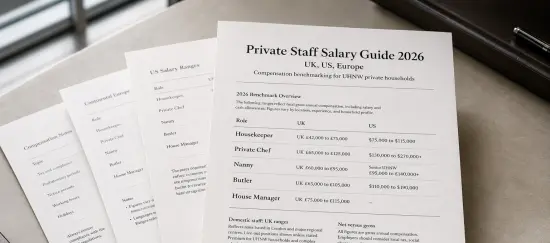
| Component |
United Kingdom (combined) |
United States (combined) |
| Base salary |
GBP 77,000 to 143,000 |
USD 132,000 to 220,000 |
| Accommodation |
Separate cottage or apartment on the estate (standard) |
Separate accommodation provided |
| Pension |
Employer contribution for both partners |
401(k) or equivalent for both |
| Private medical |
Full cover for both partners, often including dependants |
Full cover for both |
| Vehicle |
Shared estate vehicle or car allowance |
Vehicle provided |
| Meals on duty |
Standard |
Standard |
| Utilities |
Typically included with accommodation |
Typically included |
| Holiday |
Coordinated time off, with relief cover arranged |
Coordinated time off |
This often represents better value than hiring an Estate Manager and a House Manager separately, particularly when accommodation, benefits and recruitment costs are factored in.
Common hiring mistakes (and how to avoid them)
Hiring a Domestic Couple and expecting management. This is the most common mistake. A couple who have spent their career cooking, cleaning and gardening will not suddenly become managers of staff and budgets. Recruit for management experience explicitly. Oplu makes this distinction at the briefing stage.
Assessing only one partner thoroughly. Both partners must be strong. A brilliant Estate Manager married to an indifferent housekeeper is not a Management Couple. It is one good hire and one compromise. Oplu interviews and assesses each partner individually as well as together.
Failing to provide adequate accommodation. The accommodation must be genuinely separate from the main house, with its own entrance, kitchen and living space. A staff bedroom in the attic is not acceptable. Poor accommodation is the fastest way to lose a good Management Couple.
Not defining the split of duties. If both partners arrive without a clear understanding of who owns what, confusion follows. Oplu defines the division of responsibilities before the couple starts.
Ignoring the relationship dynamic. A couple under personal strain will bring that strain into the household. Oplu assesses the stability and professionalism of the partnership as part of recruitment. A Management Couple whose relationship fractures on your estate creates an immediate staffing crisis.
What candidates at this level look for
Management Couples are a self-selecting group. They have chosen a lifestyle that combines living and working in a private estate, and they are thoughtful about which placements they accept.
Quality of accommodation. This is consistently the most important factor. A well-appointed cottage with privacy, a garden and adequate space will attract better candidates than a higher salary with poor accommodation.
Respect and autonomy. They want to be treated as professionals who manage the estate on the principal's behalf, not as servants who require constant supervision.
Reasonable time off. Live-in couples are vulnerable to the expectation that they are always available. The best Management Couples insist on defined time off, and the best principals provide it.
Why they leave. The most common reasons are inadequate accommodation, erosion of boundaries (being expected to work every evening and weekend), scope creep into purely domestic duties that undermine their management role, and lack of relief cover.
How Oplu sources and vets Management Couples
- Briefing and role design. We visit the property to understand the estate, staff structure, accommodation and expectations. We define the split of responsibilities and reporting line.
- Search and sourcing. We draw on our network and conduct targeted outreach, considering only couples where both partners are genuinely capable.
- Dual assessment. Each partner is interviewed individually, then assessed together to evaluate their working dynamic and complementary coverage.
- Reference verification. We take references for both partners, ideally from shared placements.
- Shortlist presentation. We present two to four couples with detailed joint profiles and combined compensation expectations.
- Interview coordination and offer. We manage the process through to accepted offer, advising on accommodation and package structure.
- Onboarding support. We check in at thirty, sixty and ninety days.
What you receive:
- A consultant experienced in placing Management Couples
- A clearly defined role brief with agreed division of responsibilities
- Dual-assessed shortlists with individual and joint profiles
- Compensation and accommodation benchmarking
- Interview coordination and offer support
- Ninety-day onboarding follow-up
Next steps
Related roles:
Further reading