A Head of Security is the senior strategic hire responsible for protecting a principal, their family and their assets across every residence, journey and public engagement. This is not a bodyguard role. It is the person who designs the security operation, manages the close protection team and ensures that risk is mitigated before it becomes an incident. Security that works is invisible. If the principal notices it, something has already gone wrong.
Oplu recruits Heads of Security and Close Protection Managers for ultra-high-net-worth private households and public-facing families. We scope every search to the principal's specific threat profile and lifestyle.
Head of security recruitment agency
As a specialist recruiter for senior security roles within private households and estates, we understand the difference between tactical close protection and strategic security leadership, and we hire accordingly.
Related roles
When to hire a Head of Security
Most families hire security reactively, after an incident or a scare. The best time to hire is before you need to.
- The principal's public profile has increased through media coverage, business activity or political exposure.
- The family has acquired additional residences or begun spending time across multiple jurisdictions.
- An existing close protection team has grown beyond two or three operatives and needs senior coordination.
- There has been a specific threat, intrusion or data breach that has exposed gaps in the current security posture.
- International travel has become more frequent or high-risk.
- The household has no formal security protocols and access control is handled informally or not at all.
Head of Security vs Close Protection Officer vs Estate Manager
These three roles overlap in smaller households but serve fundamentally different functions at scale.
A Head of Security designs the security programme, manages the close protection team and coordinates with law enforcement. A Close Protection Officer (CPO) executes the plan on the ground, providing physical protection during travel and daily movements. CPOs report to the Head of Security. An Estate Manager manages property and assets but is not trained in threat assessment or close protection. On larger estates, the two roles work as peers.
| Role |
Focus |
Typical mandate |
Key difference |
| Head of Security |
Strategic security leadership |
Threat assessment, team management, technology, travel security |
Sets and manages the security programme |
| Close Protection Officer |
Physical protection |
Accompanying principal, route planning, immediate response |
Executes the plan; does not design it |
| Estate Manager |
Property and asset management |
Maintenance, vendors, capital projects |
Manages the estate; not personal protection |
If the principal needs someone to walk beside them, that is a CPO. If they need someone to build and run the entire security operation, that is a Head of Security.
Which role fits your situation:
- If you need physical protection during travel and daily movements but not a full security programme, you need a Close Protection Officer.
- If you need someone to design and manage the entire security operation across residences, travel and technology, you need a Head of Security.
- If your security concern is primarily about property access, alarms and perimeter monitoring with no personal threat, your Estate Manager may be able to manage this with the right vendor support.
- If you have multiple CPOs operating without coordination or consistent protocols, you have outgrown ad hoc security and need a Head of Security to impose structure.
- If the principal's public profile is increasing and you are unsure whether the threat level warrants a dedicated security hire, start with a professional threat assessment. We can advise on this before committing to a search.
Core responsibilities and day-to-day scope
Threat assessment and security strategy
Ongoing threat and risk assessments across all residences, travel routes and public engagements. They maintain a security plan that evolves with the principal's movements, including liaison with private intelligence firms and local police.
Close protection team management
Recruiting, scheduling, training and performance-managing the close protection team, including shift planning, leave cover and protocol briefings.
Technology and physical security
Oversight of CCTV, alarm systems, access control, perimeter detection and communications equipment, including vendor relationships for installation and maintenance.
Travel security
Advance planning for all travel, including route assessment, accommodation reviews and coordination with in-country providers. For international travel, this extends to evacuation planning.
Information security and access control
The biggest security risk in most households is not external. It is poor access control, unsecured information, and staff who do not know the protocols. The Head of Security establishes and enforces who has access to what, from physical keys to digital information and the principal's schedule.
Incident management and reporting
When something goes wrong, the Head of Security leads the response and delivers a clear briefing to the principal. They document incidents, conduct reviews and update protocols.
What great looks like in practice
- They are calm under pressure and do not create drama. Their presence reassures without intruding on daily life.
- They manage the close protection team with authority and fairness, maintaining high retention and consistent standards.
- They think in systems, not incidents. Every vulnerability is addressed through a protocol, not a one-off fix.
- They communicate upwards with clarity and brevity. The principal receives exactly what they need to know, without alarm or unnecessary detail.
- They maintain strong relationships with local authorities, private intelligence providers and peer security professionals.
A tabloid photographer is spotted near the property boundary. The head of security adjusts the family's exit routes, briefs the household team, and contacts the publication's legal department. No photograph is taken. The family is unaware it happened.
The principal's travel plans change at short notice. A scheduled trip to a higher-risk jurisdiction is moved forward by 48 hours. The head of security completes an advance assessment remotely, briefs the close protection team, confirms in-country support and has a revised travel security plan approved before the jet departs. The principal notices nothing different about the journey.
An unfamiliar vehicle parks near the school gates for three consecutive mornings. The head of security runs the plates, coordinates with the school's own security team, and identifies the vehicle as belonging to a new parent. The concern is resolved quietly, the nanny is briefed, and no alarm is raised with the family.
A Head of Security who cannot brief the principal calmly and concisely after an incident will not last. Communication under pressure is the skill that separates strategic operators from tactical ones.
Compensation and package guidance
Salaries vary by threat level, team size, travel requirements and number of residences.
United Kingdom:
- Single residence, low threat profile: GBP 60,000 to GBP 90,000
- Multi-residence with travel and a small team: GBP 90,000 to GBP 130,000
- Complex, high-threat or international scope: GBP 130,000 to GBP 150,000+
United States:
- Standard residential security leadership: USD 80,000 to USD 130,000
- Multi-residence with close protection team oversight: USD 130,000 to USD 200,000
- Global responsibility or large teams: USD 200,000 to USD 250,000+
- New York, Los Angeles and Miami benchmark highest
Package elements commonly include a vehicle allowance, travel expenses, equipment budgets and, for live-in roles, accommodation.
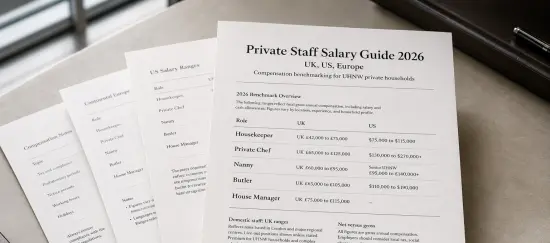
Ranges for Head of Security and comparable positions are set out in the Private Staff Salary Guide. We share benchmarks for your specific brief once the search is scoped.
Common hiring mistakes (and how to avoid them)
Hiring a bodyguard when you need a strategist. A strong CPO is not automatically a strong Head of Security. Tactical excellence does not guarantee the ability to design a security programme or manage a team.
No clear authority. The Head of Security must have the authority to enforce protocols across the household. If they can be overruled by a house manager on access control or by a PA on schedule disclosure, the security operation is compromised from day one.
Treating security as an afterthought. Bolting a Head of Security onto a household with no protocols, no budget and no principal buy-in creates a role set up to fail.
Over-indexing on military or government background. Former military and law enforcement professionals bring valuable skills, but the private household context is different. The principal expects discretion, minimal disruption and a normal life. Candidates must demonstrate they can adapt.
Skipping the brief. Security roles are highly context-dependent. A search without a clear threat assessment, scope of coverage and defined reporting line will attract the wrong candidates.
What candidates at this level look for
Senior security professionals assess a household opportunity with the same rigour they apply to threat assessments. They want to understand the principal's threat profile, the existing infrastructure and whether the household takes security seriously or treats it as a box-ticking exercise.
What motivates the best candidates is professional respect and operational authority. They need the mandate to enforce protocols across the entire household, including with staff who outrank them in other hierarchies. They want a realistic budget, direct access to the principal for critical decisions and the freedom to build or restructure the team as needed.
They leave roles when their authority is undermined. A head of security who is overruled by a PA on schedule disclosure or by a house manager on access control will not stay. They also leave when the principal demands invisible security but refuses to follow basic protocols, creating an impossible brief.
When evaluating an opportunity, experienced candidates ask about previous security incidents, existing technology infrastructure, team size and quality, and the principal's attitude to personal security. Red flags in a brief include no defined budget, a history of bypassing security protocols for convenience, shared authority with non-security staff, and a principal who views the head of security as a driver or personal assistant with a different title.
How Oplu hires Heads of Security
We begin with a scoping conversation covering the principal's threat profile, residences, existing infrastructure, team size, travel patterns and reporting line. This produces a brief that defines the role precisely.
From that brief, we run a discreet, direct search. Candidates are approached individually with controlled disclosure and assessed against technical requirements and the principal's expectations for discretion and cultural fit. We test scenario judgement as part of the process, including how candidates respond to incidents, brief upwards and balance security with the principal's desire for a normal life.
What you receive
- A scoped brief with clear responsibilities, coverage, reporting line and boundaries
- A discreet search with controlled disclosure and direct outreach
- A deliberately small shortlist built for comparison and decision-making
- Written profiles covering role-fit, working pattern, compensation expectations and notice period
- Referencing where possible, staged to protect privacy
- Offer support and transition planning to reduce churn
Next steps
- Hiring now: share a brief and we will confirm scope, threat profile and the right level before search
- Shortlist: expect a small, decision-ready shortlist with role-fit and expectations aligned
- Related roles: explore Estate Manager, House Manager
- Candidates: explore current opportunities on our job board
Further reading