Butlering is a serious profession. At the senior level it pays well, demands real technical skill, and rewards consistency over decades. This guide explains how the modern butler market actually works, what backgrounds employers hire from, what compensation looks like in 2026, and how to position yourself for placement in a UHNW household.
It is written for hospitality professionals considering the move, for newer butlers planning the next decade, and for candidates from related fields (yachts, cruise, diplomatic) thinking about land-based private service.
For the role definition see What Is a Butler?. For employer-side hiring see Butler Recruitment Guide.
For current vacancies see our job board. To discuss a search get in touch.
What private butlering involves
The role is wider than the fictional version. The modern butler runs the front-of-house in a UHNW residence: principal service, guest hospitality, household orchestration, and the standard of everything the principal sees.
Day-to-day, this means handling the principal's morning routine and personal preferences, coordinating with kitchen and housekeeping, managing service for meals and entertaining, training and supervising any junior front-of-house staff, and being present and discreet through the rhythms of the residence.
The job is physical, presence-led, and rhythmic. It rewards stamina, anticipation, and consistency over decades. It is not glamorous, but the financial and lifestyle rewards at the senior level are real for the right temperament.
The pathways in
Three are the main routes.
Five-star and ultra-luxury hospitality. Butler programmes at properties like Claridge's, The Connaught, the Savoy, the Mandarin Oriental, the Ritz-Carlton, and equivalent international properties. The most common pipeline. Strong technical training and exposure to high-net-worth guests.
Specialist butler schools. The British Butler Institute, Magnums Butlers, the Butler Academy, the Australian Butler School, the International Butler Academy in the Netherlands. Most senior butlers have done at least one of these on top of hospitality experience.
Adjacent service backgrounds. Royal or sovereign households (rare but well-regarded), diplomatic service residences, yacht service, and senior cruise crew. Adjacent skills with strong direct transfer to private butlering at mid-career.
A small number of butlers also enter through direct junior placements in private households where they learn under a Head Butler. The route is real but slower than the hospitality-into-butlering route.
The career path to senior butler typically takes ten to fifteen years of consistent work. The pool at the senior level is small. Most placements run through specialist firms or direct introduction.
What employers look for
The dimensions principals interview for.
Service instinct. The strongest candidates describe their work in terms of what the principal experienced, not what they did. Calm, anticipatory, present-without-intrusion presence.
Memory and consistency. Holding hundreds of small preferences in mind, every day, for years. Strong butlers do this without notes. Weak butlers either do not retain the preferences or have to be reminded.
Discretion and trust. A small market. Reference checks reveal everything. A single incident of a story leaking back ends a butler's career.
Cultural range. International principal households need butlers who can host and run service across different cultural expectations. Languages help.
Continuous development. The strongest butlers continue to invest in their craft over decades. Formal courses, time at respected institutions, language study, training in specific service traditions.
We assess for these in interview. CV review filters for technical track record. The behavioural fit decides the placement. For more on how we filter at the interview stage see How Oplu Selects Candidates.
Training and qualifications
There is no single required credential. The strongest profiles include some combination of the following.
Hospitality experience. Five-star or ultra-luxury hotel training in rooms division, butler service, or related front-of-house roles. Three to five years minimum before private service.
Specialist butler school. The British Butler Institute (UK and US programmes), Magnums Butlers (UK and Asia programmes), the Butler Academy (Netherlands), the Australian Butler School. Each has a different style and emphasis. The certificate carries weight on a CV at the mid-senior level.
Specialist depth. Wine and sommelier qualifications (WSET levels), service of formal dinners, table craft, valet skills, household management training. These are differentiators at the senior level.
Languages. Useful for international principal households. Not required, but a clear differentiator at the senior level.
Time at recognised households. Time in royal, sovereign, or well-known private households is valuable on a CV but rare. Most senior butlers come through hotel and butler-school routes rather than household routes.
What private butlers earn in 2026
UK ranges from Oplu placement experience.
Junior butler. £40,000 to £60,000 base. Live-in arrangements common at this level.
Mid-level butler, single residence. £55,000 to £80,000 base.
Senior butler, principal household. £70,000 to £100,000 base. Bonus 5% to 15%.
Head butler, multi-staff team. £85,000 to £130,000 base. Bonus 10% to 20%.
Head butler, large estate or ultra-luxury principal household. £100,000 to £150,000 base. Total compensation £115,000 to £180,000+.
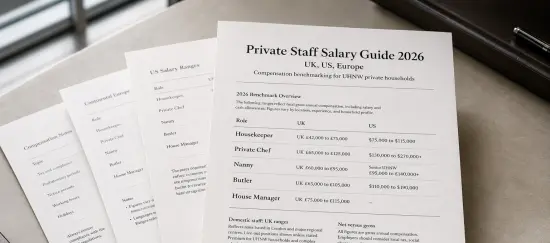
US equivalents pay 30% to 50% more at comparable seniority. Yacht butler compensation is structured monthly and paid largely tax-free where conditions are met. For full domestic compensation context see our Private Staff Salary Guide 2026. For why generic published data for these roles is unreliable see Why Published Salary Data Is Misleading.
How to get hired
Five practical steps.
Build a focused CV. Specific properties (or anonymised types where confidentiality requires it), specific responsibilities, specific specialisms (formal service, wine, valet, languages), specific tenure. Generic descriptions tell employers nothing.
Get your references in order. Direct references from Head Butlers, House Managers, hotel general managers, or principals you have served. Generic course tutors are not useful at the senior level. The strongest references are from senior practitioners.
Specialise. Generalists are common. Butlers with depth in one or two areas (wine, valet, formal English service, international service traditions) stand out at the mid and senior level.
Maintain professional development. Specialist courses, attendance at industry events (the British Butler Institute conferences, the Butler Academy alumni networks), language study. The visible commitment to the craft matters.
Engage the right firm. Specialist private recruitment firms know which households are hiring. Generic domestic agencies and online platforms rarely give access to the senior pool. For what to expect from a professional engagement see What to Expect When You Engage a Private Recruitment Firm.
What slows people down
Three patterns cost candidates the placement at the senior level.
Over-formality. Some candidates trained in older traditions struggle to adapt to the more functional modern butler role. UHNW principals today usually want anticipation and calm presence, not stiff formality.
Hospitality identity. Butlers from hospitality backgrounds sometimes carry a brand or property loyalty that does not translate to private service, where loyalty is to the principal directly.
Reluctance to do household work. Senior butlers are often expected to step into kitchen, housekeeping, or driver coverage during gaps. Candidates who refuse to do anything outside front-of-house service struggle in real households.
For more on common hiring and structural mistakes see Common Hiring Mistakes in Private Offices.
Career progression
A typical senior career path.
Years 1-5. Junior butler or hospitality background. Build technical skill. Develop references.
Years 5-10. Mid-level butler, single residence. Develop a specialism (wine, valet, formal service). Begin to take on training of junior staff.
Years 10-15. Senior butler, principal household. Hold standards. Possibly first head butler role in a smaller household.
Years 15-25. Head butler, larger residences. Lead a front-of-house team. Hold the standard across the residence.
Years 25+. Head butler at the most complex residences, Director of Households for multi-residence principals, butler training and consultancy, or estate-manager-track if the candidate has the operational temperament for it.
Some senior butlers move into related areas: estate manager, director of residences, butler school instruction. Others stay at head butler level by choice for the lifestyle and the steadiness. Both are legitimate.
How Oplu places butlers
We work across the butlering function from junior placements to head butler and Director of Residences. Our process is the same at every level: scoping the brief in detail, running the search through our network of placed and known butlers, interviewing in depth, and presenting a small shortlist with full written profiles.
For candidates, we are happy to have introductory conversations early in your career. The butler pool we work with is built over years.
For current vacancies see our job board. To discuss a search get in touch.
Further insights from the Oplu series