One mis-sent thread can land badly. Oplu runs family office executive assistant recruitment for principals and private offices that need tight control of time, access, and information.
A strong EA makes the principal's day calmer and the office safer. A weak one creates friction, leakage, and avoidable cost. In high-trust environments, baseline admin skills are table stakes. Judgement is what keeps things safe.
Executive Assistant recruitment agency
Oplu runs discreet, controlled searches for principal-facing EAs in Family Offices worldwide. Often these are replacement hires, so we stage disclosure and keep the circle tight.
Related roles
When to hire an Executive Assistant in a family office
Hire when the principal's time, access, and decision flow are being managed reactively rather than deliberately.
You typically need an EA now if:
- The principal is still handling inbox triage, travel changes, or meeting preparation
- Inbound stakeholders are too many and gatekeeping is inconsistent
- The office runs on memory, not clean briefing notes and reliable follow-through
- Sensitive conversations are happening without control of who sees what
- The principal is interrupted for decisions that should have been pre-framed
The diary in a family office is not just a schedule. It is an information gate. Whoever controls it shapes what the principal sees, when, and from whom.
Executive Assistant vs Personal Assistant vs Chief of Staff
| Role |
Focus |
Typical mandate |
Key difference |
| Executive Assistant |
Executive workflow, diary, stakeholder gating |
Principal's professional rhythm |
Controls time and information flow |
| Personal Assistant |
Lifestyle, travel, household coordination |
Principal's personal continuity |
Manages the private sphere |
| Chief of Staff |
Delivery, decision cadence, cross-stakeholder |
Operating rhythm across workstreams |
Needs authority to close decisions |
If the role is mostly diary, travel, inbox, and stakeholder management, it is an EA. If it is lifestyle-first with household and personal logistics, it is a PA. If it is delivery and decision cadence across workstreams, it is a Chief of Staff. Titles blur in private offices, but scope should not.
Which role fits your problem
- If your problem is that the principal's time is managed reactively and stakeholder access has no gatekeeper, hire an Executive Assistant.
- If your problem is that personal logistics, travel, and household coordination are falling behind, hire a Personal Assistant.
- If your problem is that workstreams stall because nobody integrates decisions across advisers and projects, hire a Chief of Staff.
- If your problem is that the office admin cadence has no owner and documentation is unreliable, hire a Family Office Assistant.
- If your problem is that you are a founder hiring personal support for the first time with no existing infrastructure, hire a Private PA.
Core responsibilities and day-to-day scope
- Calendar architecture: priorities, buffers, sequencing across locations and time zones
- Meeting hygiene: agendas, briefing notes, attendee control, follow-up actions
- Inbox triage: drafting, escalation rules, response cadence
- Stakeholder management: gatekeeping, tone calibration, sensitive relationship handling
- Travel planning: itineraries, contingencies, changes handled quietly
- Document readiness: packs, naming, version control
- Expenses and approvals: clean trails without bottlenecks
- Light project coordination where it protects the principal's time
Confidentiality, boundaries, and decision-making authority
We define these upfront: who can instruct, what can be actioned without approval, spend limits, and access to sensitive information. We will not run a search without clear lines on access, authority, and confidentiality.
What great looks like in practice
- Calm triage under pressure, with the right instinct for what escalates and what waits
- Authority without ego when managing senior stakeholders
- Precision with details that matter: names, timings, sensitivities
- Controlled information flow. Nothing leaks by accident
- Consistent follow-through systems that survive busy weeks
The principal lands from New York at 6am. Three meetings need moving. The accountant has sent documents that need sign-off before noon. The school calls about pick-up. The EA has ninety minutes to triage all of it before the first call. By the time the principal opens their phone, there is a single message: one decision needed, two items handled, one rescheduled with options.
A wealth adviser emails asking to be added to a family governance meeting. The EA checks the attendee protocol, confirms the adviser is not on the approved list, declines politely without revealing the meeting agenda, and flags it to the principal at the right moment. No friction. No leak.
A good EA does not just manage the diary. They decide what the principal sees, when they see it, and what never reaches them at all.
Compensation and package guidance
EA compensation in a family office depends on access, hours, travel, and scope. In our experience, UK packages typically range from £45,000 to £85,000, with senior EAs to principals in complex multi-entity offices reaching higher. US packages typically range from $80,000 to $190,000, with New York benchmarking approximately 15% above the national average. At the senior end, total compensation including bonus can reach $240,000. An Executive Personal Assistant we placed received a bonus of over €500,000 in a single year. At the senior end, support staff compensation in UHNW environments bears no resemblance to published salary guides.
In these roles, the salary covers everything. There is no overtime structure. The hours are long, and the strongest candidates know that before they accept.
Key drivers include: number of stakeholders managed, travel cadence, out-of-hours expectations, and whether the EA holds any gatekeeping authority over adviser access.
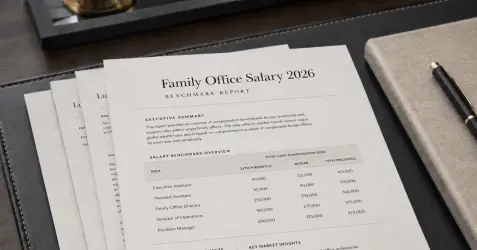
Ranges for Executive Assistant and comparable positions are set out in the Family Office Salary Guide. We share benchmarks for your specific brief once the search is scoped.
Common hiring mistakes (and how to avoid them)
- Hiring a PA when the real need is executive workflow. If the priority is stakeholders, decision flow, and meeting cadence, that is an EA, not a PA with office duties bolted on.
- Blurring household and office support without boundaries. Unless authority and information rules are defined, the role will drift and the person will burn out.
- Over-indexing on brand names. A strong corporate EA may not handle family dynamics, adviser politics, or the pace of a private office. Test for adaptability, not pedigree.
- Under-defining pace and availability. Travel cadence, time zones, and what "urgent" means after hours must be agreed before the search starts. Ambiguity on availability is the fastest route to short tenure.
- Treating discretion as assumed rather than validated. Reference for information handling, not just task completion. Ask what access they were trusted with and how they managed it.
- Hiring a candidate taking a significant pay cut. If a candidate is taking a significant pay cut, we ask why. If the answer is necessity, the placement rarely lasts. Salary alignment is a retention decision, not just a budget line.
What candidates at this level look for
The best family office EAs are not looking for a job. They are looking for a principal they can trust and a structure that will not burn them out. They leave roles when boundaries dissolve: when personal errands consume the professional mandate, when out-of-hours expectations are undefined, or when they are blamed for decisions they were never given authority to make.
What keeps them is clarity. A defined reporting line. A principal who respects the gatekeeper role rather than undermining it by giving direct access to everyone. An office that distinguishes between urgent and important, rather than treating everything as both.
During interviews, strong EA candidates assess the brief itself. They listen for specifics on diary authority, stakeholder boundaries, and what happens when the principal's spouse or family member calls with a conflicting request. If the brief is vague on coverage hours, they assume the worst. If tenure history is short, they ask why directly.
Red flags include: a role that has been filled three times in four years, a principal who cannot articulate what the EA should not do, and an office where the Chief of Staff or family member also instructs the EA without coordination. They know that dual reporting without rules is the fastest path to burnout and departure.
How Oplu hires Executive Assistant
We assess behaviour in practical scenarios: diary and inbox triage under conflicting requests from principal, adviser, and family member. Travel disruption and how options are communicated. Sensitive information handling, board packs, NDAs, and how notes are managed.
We listen for calm prioritisation, precise questions, and a bias for protecting confidentiality. Referencing validates judgement and boundary handling, not just competence.
What you receive
- A scoped brief with clear responsibilities, coverage, reporting line and boundaries
- A discreet search with controlled disclosure and direct outreach
- A deliberately small shortlist built for comparison and decision-making
- Written profiles covering role-fit, working pattern, compensation expectations and notice period
- Referencing where possible, staged to protect privacy
- Offer support and transition planning to reduce churn
Next steps
- Hiring now: share a brief and we will confirm scope, coverage and the right level before search
- Shortlist: expect a small, decision-ready shortlist with role-fit and expectations aligned
- Related roles: explore Chief of Staff, Personal Assistant, Family Office Assistant
- Candidates: explore current opportunities on our job board
Further reading