Oplu places Chiefs of Staff into high-trust private environments where confidentiality is non-negotiable and priorities move quickly. This is family office chief of staff recruitment for principals who need one operator to turn decisions into outcomes.
If the role has no real authority, it will stall. We scope mandate and access before we speak to the market.
Chief of Staff recruitment agency
Oplu runs discreet, controlled searches for Chiefs of Staff in Private and Family Offices. Many are replacement or transition hires, so confidentiality and staged disclosure are part of the process design, not marketing language.
Related roles
When to hire a Chief of Staff
Hire when priorities are sound but execution is inconsistent because the office has outgrown informal coordination.
This is usually the right hire when:
- Multiple workstreams run across investments, property, lifestyle, philanthropy, governance, or operating businesses
- The calendar is full, but outcomes feel light
- The same issues resurface because decisions are not captured, delegated, or checked
- Advisers provide inputs, but nobody integrates them into one plan
- The principal is the bottleneck for routine unblocking
If the principal wants to remain the only decision-maker, the hire will stall. A Chief of Staff needs delegated authority to close decisions through others.
Chief of Staff vs Executive Assistant vs Personal Assistant
| Role |
Focus |
Typical mandate |
Key difference |
| Chief of Staff |
Delivery, decision cadence, cross-stakeholder coordination |
Operating rhythm across workstreams |
Needs authority to convene and close |
| Executive Assistant |
Executive workflow, diary, stakeholder gating |
Principal's professional rhythm |
Manages access and information |
| Personal Assistant |
Lifestyle, travel, household coordination |
Principal's personal continuity |
Manages the private sphere |
The Chief of Staff operates across workstreams. The EA operates within the principal's executive rhythm. The PA operates within the principal's personal life. If the need is coordination across all three, that is a Chief of Staff mandate, not an EA with a bigger title.
Which role fits your problem
- If your problem is that nobody integrates adviser inputs into a single plan and workstreams stall between meetings, hire a Chief of Staff.
- If your problem is that the principal's diary, inbox, and stakeholder access are managed reactively, hire an Executive Assistant.
- If your problem is that personal logistics, travel, and household coordination are falling through the cracks, hire a Personal Assistant.
- If your problem is that the office engine room is unreliable and admin cadence has no single owner, hire a Family Office Assistant.
- If your problem is that you have outgrown informal coordination but the office does not yet have governance infrastructure, hire a Director of Operations.
Core responsibilities and day-to-day scope
- Convert priorities into a delivery plan with owners, milestones, and decision points
- Run a weekly operating rhythm and protect it when pressure rises
- Create decision clarity across stakeholders who are not direct reports
- Manage sensitive information with restraint and sound judgement
- Keep projects moving without becoming the doer of everything
- Coordinate between principal, family, advisers, vendors, and internal teams with controlled disclosure
Reporting lines and authority
Most structures keep the principal as ultimate authority, but day-to-day decisions should sit with the Chief of Staff and a defined escalation path. We map decision rights, spend thresholds, and escalation rules before search to avoid hiring for a title with no operating power.
What great looks like in practice
- Fewer meetings, more decisions
- Clean notes with owners, dates, and escalation routes
- Calm stakeholder handling without over-sharing
- Structured progress that survives busy weeks
- A light governance cadence with real follow-through
The principal is in transit between Zurich and London. The wealth adviser has sent a revised investment memo that conflicts with a commitment made to a philanthropic board last week. The property team needs sign-off on a planning application before close of business. The family lawyer wants fifteen minutes to discuss a trust restructuring. The Chief of Staff reviews the memo, flags the conflict, sequences the calls, and sends the principal a single-page brief before wheels down. No surprises, no bottleneck.
A board pack needs to go to three advisers in different jurisdictions. One adviser should not see the family trust summary. Another needs a redacted version of the asset schedule. The Chief of Staff builds two versions, controls distribution, confirms receipt, and logs it. No one asks the principal to check.
If they cannot convene the right people and close decisions, the title is cosmetic.
Compensation and package guidance
Chief of Staff compensation in a family office depends on authority, breadth, proximity to the principal, and location. In our experience, UK packages typically range from £80,000 to £150,000+, with senior mandates in complex multi-entity offices reaching higher. We have placed Chiefs of Staff at £250,000 where authority and scope justified it. US packages typically range from $150,000 to $300,000+, with New York and the Bay Area benchmarking at the upper end. In larger family offices, total compensation including bonus can exceed $400,000 for roles with significant governance load. International roles with multi-jurisdiction responsibility sit at the upper end of both markets.
PAs, EAs, and Chiefs of Staff absorb hours. There is no overtime, no time-and-a-half. The salary covers everything, and the hours are long. Candidates know this. The ones who last are the ones who knew it before they accepted.
Drivers include: number of workstreams, stakeholder complexity, travel cadence, and whether the role carries budget or signatory authority.
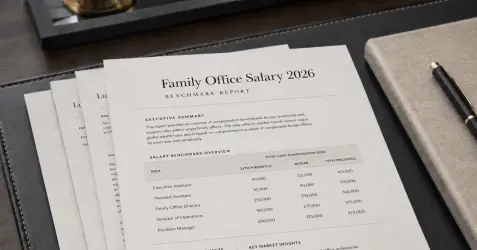
Ranges for Chief of Staff and comparable positions are set out in the Family Office Salary Guide. We share benchmarks for your specific brief once the search is scoped.
Common hiring mistakes (and how to avoid them)
- Hiring an EA and calling it Chief of Staff. If the role is diary and inbox, it is an EA. A Chief of Staff needs delivery authority, not just proximity.
- No defined mandate. Without clear decision rights, spend thresholds, and escalation rules, even strong operators burn political capital quickly. This hire fails when responsibility is delegated but authority is not.
- Over-indexing on corporate pedigree. Family office pace and discretion are different from corporate environments. Test judgement and adaptability, not brand names.
- Unclear reporting lines. If both principal and COO can instruct without coordination, the Chief of Staff becomes a buffer, not an operator.
- Skipping scenario testing. Profiles converge at this level. Test escalation, stakeholder handling, and information control through realistic scenarios, not competency grids.
- Promoting an EA into a Chief of Staff seat without testing the gap. A PA or EA who has grown with a principal from the early days often ends up in a Chief of Staff seat by default. They are loyal, trusted, and know everything. But a seasoned EA is not a Chief of Staff. The skills are different. When the office outgrows informal coordination, the gap becomes visible fast.
- Hiring a candidate who is taking a significant pay cut. When candidates accept roles at half their previous salary, retention risk is immediate. They took the job because they needed income. When a better offer arrives, they leave.
What candidates at this level look for
Chiefs of Staff at the UHNW level do not leave for money. They leave because the mandate was hollow. The title said Chief of Staff but the reality was gatekeeping, inbox triage, and no authority to close anything. The strongest candidates have seen this before and they screen for it hard.
What motivates them is genuine operating authority. They want a principal who delegates decisions, not just tasks. They want a defined escalation path, a clear reporting line, and the ability to convene advisers and hold them to deadlines without political blowback. They assess whether the principal will actually step back from day-to-day coordination or whether they will undermine every decision the Chief of Staff tries to land.
During the interview process, they are evaluating the brief as much as the office is evaluating them. They look for specifics: how many workstreams, what decision rights exist, whether spend thresholds are defined, and who else instructs. A vague brief is the first red flag. The second is a principal who describes the role as "supporting me with everything." That signals an EA seat dressed up with a senior title. The best candidates will walk away from it.
They also look for tenure patterns. If the last two hires lasted under eighteen months, they want to know why. If the answer is unclear, they assume the mandate was never real.
How Oplu hires Chief of Staff
We assess how candidates think, escalate, and protect confidentiality. We test through scenarios: a sensitive adviser request conflicting with the principal's preference, a vendor issue with confidentiality implications, competing priorities during peak travel.
We listen for calm prioritisation and a bias for documenting decisions without creating bureaucracy. Referencing validates judgement under pressure, not just task completion.
What you receive
- A scoped brief with clear responsibilities, coverage, reporting line and boundaries
- A discreet search with controlled disclosure and direct outreach
- A deliberately small shortlist built for comparison and decision-making
- Written profiles covering role-fit, working pattern, compensation expectations and notice period
- Referencing where possible, staged to protect privacy
- Offer support and transition planning to reduce churn
Next steps
Further reading