Oplu recruits private PAs for founders and entrepreneurs whose personal lives have outgrown their capacity to manage them alone. You are building at speed, your personal admin is falling behind, and you are spending hours each week on logistics that have nothing to do with your company.
You need what a UHNW principal has: a brilliant PA who can run your personal world without being told what to do. You just do not have the infrastructure yet. No family office, no household team, no systems. That is exactly where Oplu starts.
Private PA recruitment agency for founders
Oplu places private PAs with founders, entrepreneurs, and fast-scaling executives who are hiring personal support for the first time. We apply the same rigour used in UHNW family office placements to principals building their infrastructure from scratch.
Related roles
When to hire a Private PA as a founder
Most founders hire their first PA too late. By the time they realise they need one, they have already lost months of their own time to logistics they should never have been handling. These are the signals we hear most often:
- Your wealth has grown quickly and the personal complexity that comes with it is unmanaged
- You are spending time on property, insurance, vehicles, appointments, and travel that someone else should handle
- Your professional EA cannot absorb your personal workload without one lane suffering
- Advisers or lawyers are asking "who handles your personal affairs?" and there is no answer
- You have missed personal deadlines, tax filings, or renewals because nobody is tracking them
- You have tried to manage everything through your phone and it is no longer working
Private PA vs Executive Assistant vs Chief of Staff
Founders frequently try to combine personal and professional support into a single hire. It rarely works at scale. The Private PA handles personal logistics: travel, property, lifestyle, financial admin, and vendor management. The EA handles business workflow: diary, stakeholders, and executive communications. The Chief of Staff owns delivery across workstreams with decision-making authority.
| Role |
Focus |
Typical mandate |
Key difference |
| Private PA |
Personal logistics, lifestyle, admin |
Founder's private continuity |
Owns everything outside the business |
| Executive Assistant |
Business workflow, diary, stakeholders |
Founder's professional rhythm |
Controls business calendar and information flow |
| Chief of Staff |
Delivery, decision cadence, operations |
Cross-functional accountability |
Requires authority to act on the founder's behalf |
If your personal life is the bottleneck, start with a Private PA. If business operations are the bottleneck, start with an EA or Chief of Staff.
Which role fits your problem
- If your problem is that your personal life has outgrown your capacity to manage it and you have no existing support infrastructure, hire a Private PA.
- If your problem is that your business diary, stakeholder access, and executive workflow need a gatekeeper, hire an Executive Assistant.
- If your problem is that multiple workstreams across business and personal life stall because no one owns delivery end-to-end, hire a Chief of Staff.
- If your problem is that you already have a household or estate and need lifestyle and property management at scale, hire a Lifestyle Manager.
- If your problem is that you have an established family office and need a PA within that structure, hire a Personal Assistant.
Core responsibilities and day-to-day scope
- Travel. Constant, complex, and subject to last-minute changes. Flights, hotels, ground transport, visas, and contingency plans.
- Personal administration. Property, vehicles, insurance, memberships, medical appointments, and renewals.
- Financial admin support. Expense management, liaising with accountants, tracking tax deadlines, and organising documentation.
- Lifestyle logistics. Restaurants, events, gifting, personal shopping, and social calendar management.
- Vendor management. Coordinating solicitors, accountants, wealth managers, and property agents. Ensuring follow-through.
- Information management. Passwords, documents, contacts, sensitive correspondence, and personal records.
- Transition support. Establishing the systems and documentation that eventually become the foundation of a family office.
What great looks like in practice
- They learn the founder's preferences fast and act without waiting for permission. A founder PA who needs a detailed brief for every task will not survive the first month.
- They handle ambiguity without drama. The scope will be undefined for months. They build clarity rather than waiting for it.
- They manage up effectively, protecting the founder's time without becoming a bottleneck.
- They maintain absolute discretion under social and professional pressure.
- They think in systems. Even when the work feels reactive, they create structure that reduces future chaos.
The founder closes a funding round on Wednesday and decides to fly to Lisbon on Thursday for a long weekend. There is no itinerary. The PA books flights, finds a hotel the founder will like based on three previous trips, arranges ground transport, moves two personal appointments, alerts the accountant to hold expense receipts, and sends a single confirmation message. The founder boards the plane and everything is handled.
A tax deadline is ten days away. The accountant needs bank statements from two jurisdictions, proof of residence, and a signed declaration. The founder has not opened the accountant's email. The PA pulls the documents from the filing system they built in month two, chases the missing bank statement, prepares the declaration for signature, and gets it to the accountant with a week to spare. The founder signs one document.
The biggest risk with this hire is not competence. It is that the PA treats the role like a 9-to-5 when the founder's life does not have those boundaries.
Compensation and package guidance
UK: Approximately £50,000 to £90,000 depending on scope, travel, and hours. Roles with extensive travel and round-the-clock availability can reach £120,000 or more.
US: Approximately $80,000 to $160,000. New York and California benchmark highest. Founders in tech and venture capital often pay at the upper end due to pace and complexity.
These are not corporate PA salaries. The hours are long, the scope is undefined, and the right person is worth every penny.
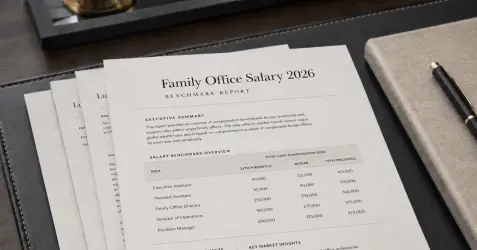
Ranges for Private PA and comparable positions are set out in the Family Office Salary Guide. We share benchmarks for your specific brief once the search is scoped.
Common hiring mistakes (and how to avoid them)
- Hiring from a corporate PA pool. Most PA agencies send candidates who have supported teams. Founders need someone who has supported a single person under pressure. The skill set is different.
- Combining the PA and EA into one role permanently. It works at first. It stops working when the business scales. Scope both roles separately, even if one person covers both initially.
- Waiting too long to hire. The cost of delay is invisible but enormous. Hire before you think you need to.
- Not defining availability upfront. Founders operate at all hours. The PA needs to know what that means: response times, weekend expectations, travel requirements. Ambiguity causes churn.
- Prioritising polish over resilience. A polished CV does not guarantee the candidate can handle the pace and ambiguity of a founder's world. Test for adaptability, not presentation.
What candidates at this level look for
Private PAs who work well with founders are a specific breed. They thrive on pace and autonomy. They leave when the founder adds complexity without adding resource, or when the role that started as personal support quietly absorbs business admin, household management, and event planning until no lane is protected and everything is half-done.
What motivates them is trust and proximity. They want a founder who delegates fully, not one who delegates then second-guesses every decision. They want the authority to act without waiting for approval on routine matters. They are drawn to founders who are building something and want their personal world to run as tightly as their business.
During interviews, they assess the founder's self-awareness. They listen for whether the founder understands what the role actually involves or whether they describe it as "just keeping things organised." They want to know if the founder has had personal support before and what happened. A founder who has never had a PA and expects perfection from day one is a warning sign.
Red flags include: a founder who cannot describe a typical week, an expectation of 24/7 availability with no discussion of compensation or boundaries, a role that combines PA, EA, and office manager into one seat with one salary, and any sign that the founder views the PA as an extension of their phone rather than a professional with judgement. The best candidates at this level will ask direct questions about scope, hours, and what success looks like in six months. If the founder cannot answer, they walk.
How Oplu hires Private PAs for founders
Oplu's experience placing PAs in UHNW environments means we know what high-trust, one-to-one support looks like. We apply the same rigour to founder placements. The trust model is identical. The difference is that we also assess for comfort with ambiguity, pace, and the absence of existing systems.
We test candidates through scenario-based interviews: a last-minute travel change, a vendor who has missed a deadline, a personal request with no context. Referencing is handled discreetly, validating how candidates managed sensitive information, responded to undefined scope, and whether they built structure or waited for it.
What you receive
- A scoped brief with clear responsibilities, coverage, reporting line and boundaries
- A discreet search with controlled disclosure and direct outreach
- A deliberately small shortlist built for comparison and decision-making
- Written profiles covering role-fit, working pattern, compensation expectations and notice period
- Referencing where possible, staged to protect privacy
- Offer support and transition planning to reduce churn
Next steps
- Hiring now: share a brief and we will confirm scope, coverage and the right level before search
- Shortlist: expect a small, decision-ready shortlist with role-fit and expectations aligned
- Related roles: explore Personal Assistant, Chief of Staff, Executive Assistant
- Candidates: explore current opportunities on our job board
Further reading