House Manager Duties and Responsibilities

Publish Date

November 6th, 2025

A House Manager is the cornerstone of efficient private household management. In luxury residences, particularly those belonging to high-net-worth (HNW) and ultra-high-net-worth (UHNW) families, the smooth functioning of daily life depends heavily on the competence and leadership of this role. Acting as the bridge between the principals and the household staff, the house manager ensures that expectations are translated into flawless execution, covering everything from budgeting to guest services.

The importance of this role goes beyond simply overseeing staff or handling logistics. In UHNW households, properties are often complex operations involving multiple employees, vendors, and intricate schedules. A skilled house manager provides structure, prevents disruptions, and delivers a level of discretion and professionalism that maintains the family’s privacy and prestige. The foundation of success for any house manager lies in three qualities: leadership, discretion, and organizational ability. Leadership ensures that household staff work cohesively and remain motivated to deliver exceptional service.

Discretion guarantees that private matters are handled confidentially, which is essential in households where privacy is a top priority. Organizational ability allows the house manager to juggle multiple duties seamlessly, from daily maintenance to high-profile events. These qualities make the role indispensable in today’s luxury property landscape, where professional household staffing has become both a necessity and a standard.

House Manager Job Description

The responsibilities of a house manager are wide-ranging, requiring both strategic oversight and hands-on involvement. Below is a comprehensive checklist of core duties, designed to reflect the house manager job description in modern private households. Each point includes a brief explanation to highlight the importance of the task.

Budgeting & Household Billing → Monitoring household expenses, managing budgets, and ensuring vendors are paid on time. A house manager must balance financial efficiency with maintaining the high service standards expected in luxury homes.

Staff Management & Supervision → Recruiting, training, and supervising domestic staff. Strong leadership ensures consistent performance, fosters teamwork, and maintains a professional household environment.

Scheduling & Household Organization → Creating and managing staff schedules, overseeing daily operations, and enforcing household rules. Organization ensures that everything runs on time and according to the principals’ preferences.

Property Maintenance Oversight → Coordinating repairs, supervising contractors, and keeping household equipment in excellent condition. Preventive maintenance protects the estate’s long-term value.

Event Planning & Guest Management → Organizing private events, managing logistics, and welcoming guests. House managers play a key role in ensuring hospitality is seamless and memorable.

Household Security & Safety → Overseeing security teams, enforcing safety measures, and ensuring compliance with regulations such as fire codes. Protecting residents and property is a top priority.

Inventory & Supply Ordering → Tracking household inventory, ordering supplies, and ensuring all essentials are available. Effective logistics reduce disruptions in daily life.

Travel & Personal Assistance → Managing travel arrangements, coordinating schedules, and providing personal support to principals. This responsibility often overlaps with a personal assistant’s role in high-end households.

Communication & Client Relations → Acting as the liaison between principals, staff, and external vendors. Clear communication is vital to keep all parties aligned and operations smooth.

Emergency & Risk Management → Responding quickly to urgent issues, from staff disputes to unexpected property problems. Crisis management is an essential skill for any house manager to ensure stability.

This checklist highlights how the house manager duties and responsibilities go far beyond simple oversight. The role combines financial oversight, staff leadership, property care, and hospitality management into a single position that is both demanding and deeply rewarding.

Core House Manager Duties and Responsibilities

While the job description outlines the scope of responsibilities, it is the real-world application of these duties that highlights the importance of the house manager’s role. Each task requires not only technical know-how but also leadership, diplomacy, and adaptability.

For example, budgeting and household billing goes far beyond paying invoices. A house manager must negotiate with vendors, evaluate cost efficiencies, and track spending across different household functions. In UHNW households where multiple residences may be managed simultaneously, financial oversight requires keen attention to detail and advanced reporting skills. Staff management is another cornerstone duty. A house manager is responsible for recruiting and training housekeepers, nannies, chefs, chauffeurs, and other domestic employees.

Unlike an estate manager, whose focus may be more on large-scale property oversight and financial planning, the house manager is deeply involved in the day-to-day supervision of staff. This means holding regular check-ins, addressing performance issues promptly, and ensuring team morale remains high.Property maintenance oversight is equally critical. From scheduling routine inspections to coordinating with contractors during renovations, the house manager ensures that the property remains safe, functional, and aesthetically flawless. This often requires quick decision-making when urgent repairs arise, such as a sudden electrical fault or plumbing issue. On the hospitality side, event planning and guest management put the house manager in a highly visible role. Whether it’s coordinating an intimate dinner party or managing logistics for a large gathering, they must ensure that every detail is executed to perfection. This involves liaising with catering staff, event planners, and security teams while also maintaining a warm, professional presence when greeting and hosting guests.

Finally, emergency and risk management highlight the critical nature of this role. From handling last-minute schedule changes to managing unexpected crises—such as a staff shortage or a household security issue—a house manager must remain calm under pressure. Their ability to proactively resolve issues before they escalate sets them apart as indispensable leaders within luxury households.

In essence, the house manager vs. estate manager distinction lies in scope: estate managers often oversee multiple estates or broader financial operations, while house managers are on the ground ensuring the daily rhythm of household life runs without interruption. As modern luxury households grow increasingly complex, the reliance on skilled house managers continues to rise.

Daily Tasks of a House Manager

The role of a house manager is as dynamic as it is demanding, and no two days are ever quite the same. To illustrate, let’s imagine a typical “day in the life of a house manager.”

The morning often begins with a review of schedules: checking staff rosters, confirming service appointments, and ensuring household tasks are allocated properly. By mid-morning, the house manager may conduct staff check-ins, walking through the property to oversee cleaning standards, confirm inventory levels, and ensure maintenance tasks are on track.

As the day progresses, the house manager might shift gears to vendor coordination—perhaps meeting with a contractor to discuss a landscaping project or reviewing billing with an external supplier. At the same time, they remain available to principals for personal assistance, whether that means confirming travel arrangements, arranging appointments, or handling private correspondence. But the role is never predictable. An afternoon might bring an unexpected issue—a last-minute dinner party arranged by the principal, a household appliance breaking down, or a staff member calling in sick. Here, the house manager’s adaptability and problem-solving skills come into play.

They must reorganize schedules, reassign tasks, and ensure service levels remain unaffected, all while maintaining composure and discretion. Evenings may include event supervision, welcoming guests, and ensuring hospitality is seamless. By the end of the day, the house manager reviews accomplishments, addresses pending issues, and prepares plans for the following day. What defines this role is the constant balance between planned routines and unexpected challenges. A successful house manager is not only a planner but also a crisis manager, capable of pivoting instantly without disrupting the flow of the household. Their adaptability, foresight, and proactive problem-solving are what transform a well-managed household into a truly exceptional one.

Essential Skills Required for a House Manager

The effectiveness of a house manager depends not only on their knowledge of household operations but also on the personal and professional skills they bring to the role. These skills form the foundation of smooth management in luxury households, where expectations are consistently high.

Leadership and Communication Skills

At its core, house management is people management. A house manager must be able to lead by example, motivate staff, and resolve conflicts diplomatically. Clear communication is essential when relaying the principal’s preferences to staff or coordinating with vendors and contractors. In high-pressure situations—such as last-minute event changes—effective communication ensures that instructions are understood and executed without error.

Customer Service and Hospitality Mindset

Luxury households operate with a service-first philosophy. House managers must anticipate needs, deliver exceptional guest experiences, and maintain a professional yet approachable presence. Whether welcoming high-profile visitors or arranging bespoke services for principals, the house manager’s ability to create comfort and satisfaction defines the household’s reputation.

Organizational and Time Management Skills

Households involve countless moving parts: schedules, events, staff shifts, and property maintenance. Strong organizational skills allow house managers to create efficient systems, prioritize tasks, and prevent disruption. Time management is equally vital, as they must balance routine operations with unexpected emergencies, ensuring that no detail is overlooked.

Technical and Practical Knowledge

Modern house management requires proficiency with budgeting tools, inventory management systems, and sometimes estate management software. A strong grasp of household finances helps avoid overspending, while practical knowledge of property maintenance, security oversight, and vendor negotiation ensures that the home remains safe and well-functioning.

Core Qualities of a Good House Manager

Beyond skills, certain qualities distinguish excellent house managers:

  • Discretion: safeguarding private information and maintaining confidentiality.

  • Adaptability: remaining flexible in the face of sudden changes or crises.

  • Attention to Detail: ensuring that even the smallest household elements—table settings, décor, or guest amenities—meet luxury standards.

Together, these skills and qualities create the reliability and trust that principals expect from a professional house manager.

Career Path & Professional Development

The journey to becoming a house manager is rarely linear, but most professionals build on a background in hospitality, luxury service, or private household support. The progression reflects both skill development and exposure to high-standard service environments.

How to Become a House Manager

Many house managers begin in roles such as personal assistants, butlers, or hospitality supervisors, where they gain experience managing people and delivering premium service. Over time, they transition into positions of greater responsibility within private households. A strong understanding of service protocols, etiquette, and property management lays the groundwork for advancement.

Training Programs and Certifications

While not always mandatory, specialized training significantly enhances career prospects. Programs in household management, private service training, or certifications such as Certified Household Manager (CHM) or Butler Academy diplomas provide structured knowledge in budgeting, staff supervision, and luxury service standards. Estate and property management courses can also broaden expertise for those who aim to transition toward estate management roles.

Resume Tips and Interview Preparation

To stand out, a house manager’s resume should emphasize measurable achievements: cost savings achieved through effective budgeting, successful coordination of high-profile events, or proven staff leadership. During interviews, candidates should prepare to highlight discretion, leadership style, and adaptability—often using the STAR method (Situation, Task, Action, Result) to demonstrate real-life examples.

Career Growth Opportunities

House managers who demonstrate excellence often find opportunities to advance into larger estates, international households, or estate management roles overseeing multiple properties. Others may transition into consultancy, training, or executive staffing services for UHNW households. As demand for skilled professionals in luxury property management continues to rise, experienced house managers enjoy strong long-term prospects in the private service sector.

Salary Expectations & Job Opportunities

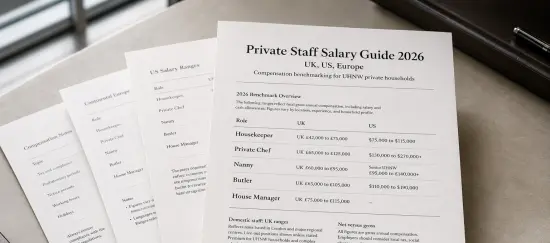
The salary of a house manager can vary widely depending on geography, household size, and the complexity of the role. In general, compensation reflects not only the scope of responsibilities but also the expectations of the principals and the lifestyle of the household.

Typical Salary Ranges

In the United States and Western Europe, house managers in private households typically earn between $70,000 and $150,000 annually. In regions with a high concentration of UHNW families, such as London, New York, Dubai, or Monaco, salaries can exceed these benchmarks, particularly for roles that include management of multiple residences, extensive staff, or responsibility for large-scale events. In smaller households or less competitive markets, compensation may range from $50,000 to $80,000, though packages often include accommodation, meals, or travel allowances.

House Manager vs Estate Manager Salaries

While house managers focus on the day-to-day operations of a single residence, estate managers often oversee multiple properties, expansive grounds, or corporate assets. As a result, estate manager salaries typically outpace those of house managers, averaging $120,000 to $200,000+ annually. However, an experienced house manager in a prestigious UHNW household can earn a salary comparable to entry-level estate managers, especially if they demonstrate exceptional leadership and discretion.

Market Demand in Luxury Households

The demand for professional house managers continues to rise globally as UHNW families increasingly recognize the value of structured household operations. Growth markets include Asia and the Middle East, where new luxury estates are being developed at a rapid pace. International placements are especially attractive for house managers with multilingual skills and experience in cross-cultural service environments.

Ultimately, house management is one of the most secure roles within private service. As wealth expands and households become more complex, the need for reliable, professional house managers ensures consistent job opportunities and career longevity.

Challenges Faced by House Managers

Despite its many rewards, the role of a house manager comes with unique challenges that require resilience, adaptability, and diplomacy.

Staff Conflicts and Team Management

Households with multiple staff members can encounter interpersonal conflicts, differences in work styles, or issues of accountability. The house manager must act as mediator, enforcing professionalism while maintaining harmony among the team. Strong leadership and conflict resolution skills are vital in preserving both efficiency and morale.

Balancing Personal Assistance with Operational Duties

A recurring challenge is finding the right balance between administrative responsibilities and personal support for principals. On any given day, a house manager may shift from reviewing budgets to arranging private travel itineraries or handling personal errands. This dual role requires flexibility and careful prioritization to ensure both the household and the principal’s personal needs are met.

Emergency Management and Last-Minute Changes

No matter how well-planned a schedule may be, emergencies are inevitable—equipment failures, sudden guest arrivals, or staff absences. A successful house manager thrives in these high-pressure moments, relying on resourcefulness and proactive planning to minimize disruption. The ability to remain calm under pressure is often the defining trait of top professionals in this role.

Confidentiality and Trust Issues

Working in private households demands absolute discretion. House managers often handle sensitive information, from financial details to personal routines. Any breach of trust can jeopardize both the role and the reputation of the household. For this reason, principals seek house managers with a proven track record of confidentiality, integrity, and discretion.

While these challenges can be demanding, they also highlight why skilled house managers are so highly valued in UHNW households. Those who can navigate conflict, balance competing priorities, and safeguard trust become indispensable to the families they serve.

Importance of a House Manager in Luxury Households

In UHNW and luxury households, the house manager is the cornerstone of seamless daily life. Their work extends far beyond scheduling or budgeting — they create an environment where principals, family members, and guests can focus on comfort, security, and prestige without disruption.

Central to Seamless Household Operations

The house manager is the operational anchor of the residence. By coordinating staff, supervising maintenance, and handling day-to-day logistics, they ensure that the home runs like a finely tuned system. Every detail, from household inventory to guest arrivals, is managed with precision to prevent inconvenience or oversight.

Contribution to Security, Prestige, and Guest Experience

House managers are also instrumental in safeguarding the household. Overseeing security protocols, ensuring compliance with safety standards, and liaising with private security teams help protect both people and property. Equally important is their contribution to the household’s prestige. In high-profile environments, guests often judge a household by its hospitality. The house manager’s role in guest relations — from greeting arrivals to orchestrating events — directly shapes the reputation and standing of the residence.

Long-Term Role in Maintaining Comfort and Excellence

Unlike short-term staff or contractors, house managers often hold long-term positions, becoming trusted advisors to the principals. They ensure continuity, preserve traditions, and adapt to evolving needs — whether that means integrating new technologies, coordinating international travel, or planning a series of high-profile events. In doing so, they become indispensable to the sustained comfort and excellence that UHNW households demand.

Conclusion & Call to Action

The role of a house manager is defined by complexity, leadership, and discretion. From financial oversight to guest services, from property maintenance to crisis management, house managers carry the responsibility of transforming luxury households into well-run, secure, and welcoming environments. Their ability to balance operational efficiency with personal service makes them one of the most valuable professionals in private household staffing.

Strong leadership and organizational skills are what distinguish successful house managers. They must inspire staff, maintain confidentiality, and anticipate challenges before they occur — all while ensuring that the principals’ expectations are consistently exceeded. For households that value excellence, prestige, and peace of mind, the presence of a skilled house manager is not a luxury but a necessity.

If you are seeking the right professional support for your private residence or are exploring career opportunities in luxury household management, explore our dedicated services:

Oplu

Oplu

Oplu Team