Estate Manager Interview Questions & Preparation

Publish Date

November 6th, 2025

An Estate Manager is the cornerstone of smooth operations in private households, luxury residences, and ultra-high-net-worth (UHNW) estates. At its core, the estate manager job description involves overseeing the daily functions of one or multiple properties while ensuring that staff, budgets, and logistics align with the expectations of principals and property owners. The role requires balancing administrative oversight with practical responsibilities, making the estate manager both a leader and an operator.

The estate manager responsibilities often include staff management, financial oversight, vendor coordination, event planning, property maintenance, and risk management. However, the scope of the role can vary widely depending on the household or estate. For example, in a single luxury residence, the estate manager may be deeply involved in personal assistance and scheduling, while in a multi-property UHNW family office, the role could lean toward high-level strategy, budgeting, and technology adoption.

One common question is how an estate manager differs from a property manager. A property manager typically handles the leasing, upkeep, and tenant-related concerns of investment properties, working in a commercial or rental context. An estate manager, by contrast, manages private, often owner-occupied estates, with a focus on hospitality, discretion, and household operations. Estate management is as much about people and experiences as it is about property maintenance.

The importance of estate management in luxury households cannot be overstated. For UHNW families and royal households, the estate manager ensures seamless operations behind the scenes, maintaining the prestige, comfort, and security of the residence. Their leadership allows principals to focus on their business, travel, or philanthropic endeavors, confident that the estate is in capable hands. In essence, the estate manager embodies trust, professionalism, and organizational excellence in one of the most demanding service industries.

Essential Skills and Qualifications for Estate Managers

The estate manager role requires a diverse blend of hard and soft skills, blending technical knowledge with leadership and interpersonal abilities. Unlike many professions, this role demands both strategic thinking and day-to-day problem solving, often under high pressure and with limited room for error.

Key skills needed for estate management include:

  • Leadership and Staff Management: Estate managers must recruit, train, and oversee domestic staff while creating a cohesive team culture that aligns with household values.

  • Organizational and Project Management Skills: From coordinating household schedules to overseeing renovations and events, estate managers are responsible for ensuring operations run smoothly.

  • Financial Management: Budgeting, handling household billing, vendor contracts, and tracking expenses are core parts of the job. A strong estate manager balances cost-efficiency with maintaining the highest standards of service.

In addition to these core skills, modern estate managers are increasingly expected to have technical expertise. Familiarity with estate management software, digital scheduling platforms, and smart home systems is becoming essential. Competence in property maintenance oversight and risk management strategies ensures that estates remain both functional and secure.

Equally important are soft skills. Estate managers must demonstrate exceptional communication abilities, discretion, and an ability to adapt to different household cultures. Cultural fit is especially vital in UHNW households where confidentiality and professionalism are paramount.

The career path to becoming an estate manager often begins in related fields such as hospitality, luxury hotel management, personal assistance, or property management. Many professionals pursue estate management courses or certifications to build credibility and learn specialized skills. Organizations and training programs dedicated to private service can provide essential education in leadership, luxury service standards, and advanced property management techniques. With experience and ongoing development, an estate manager can advance to overseeing multiple estates or move into consulting roles within the luxury household sector.

Common Estate Manager Interview Questions

When preparing for an estate manager job interview, candidates can expect a wide range of questions designed to assess their background, practical experience, and leadership abilities. Employers want to understand not only whether you can manage the operational side of a luxury estate but also whether you can fit seamlessly into the household’s culture.

General background and experience-based questions are typically asked first to establish your professional history. These might include:

  • “Can you walk us through your career path and explain how your past roles prepared you for estate management?”

  • “What attracted you to a career as an estate manager, and what do you enjoy most about this profession?”

From there, interviewers usually shift into questions focused on estate manager duties and responsibilities. Since the role requires juggling everything from staff management to vendor negotiations, you may be asked about:

  • How do you prioritize tasks when managing multiple properties or projects at once?”

  • “What systems do you use to track household expenses and vendor contracts?”

Another common area of focus is leadership and staff management. Estate managers oversee household staff, so employers want to know how you motivate teams and handle interpersonal challenges.

Expect questions such as:

  • “How do you recruit, train, and retain high-quality domestic staff?”

  • “Can you describe a time when you had to resolve a conflict between staff members?”

Because the role involves constant interaction with principals, guests, and vendors, strong communication skills and guest relations are essential. Interviewers may ask:

  • “How would you welcome and manage VIP guests in the household?”

  • “What steps do you take to maintain clear communication with principals while protecting their privacy?”

Finally, estate managers are often evaluated on time management and organizational efficiency. Questions here might include:

  • How do you structure your day to balance routine tasks with unexpected issues?”

  • “What methods do you use to ensure that household operations remain seamless, even under pressure?”

Together, these questions help employers build a full picture of a candidate’s professional capacity, personality, and ability to thrive in high-pressure UHNW environments.

Behavioral & Situational Interview Questions

Beyond technical skills and experience, employers also want to know how an estate manager reacts under real-world conditions. That’s why behavioral and situational interview questions are so common in this field. These questions reveal how you think, problem-solve, and adapt when faced with challenges.

A frequent area of exploration is problem-solving. Candidates may be asked:

  • “Can you describe a time when a major issue—such as a security failure or last-minute event change—threatened the household’s operations, and how you resolved it?”

Closely related are conflict resolution and adaptability scenarios. For example:

  • “Tell us about a situation where you had to mediate a dispute between household staff or vendors. What approach did you take, and what was the outcome?”

  • “How have you adapted when principals changed their plans at the last minute or requested urgent travel arrangements?”

Another critical category is cultural fit interview questions. Since estate managers work in highly personalized environments, employers want to know that you can align with the household’s values. They might ask:

  • “How do you maintain discretion and confidentiality while still building trust with principals and their families?”

  • “What do you think is the most important quality for working in a private UHNW household?”

Some employers also use day-in-the-life or scenario-based estate manager questions to evaluate organizational skills and judgment. For example, you might be asked to walk through how you would structure a day that includes staff scheduling, a scheduled vendor repair, and preparation for an evening dinner party.

The best way to answer these types of questions is by using the STAR method (Situation, Task, Action, Result). This approach allows you to provide structured, clear, and outcome-focused answers:

  • Situation: Briefly explain the context of the challenge.

  • Task: Describe your responsibility in addressing it.

  • Action: Outline the specific steps you took to resolve it.

  • Result: Highlight the positive outcome, ideally quantifiable or clearly impactful.

For example, when asked about conflict resolution, you could explain the staff disagreement (Situation), your responsibility as a leader (Task), the steps you took to mediate (Action), and the improved teamwork that resulted (Result). Using STAR helps you demonstrate not only what you did but also how your actions added measurable value to the estate.

Technical & Role-Specific Interview Questions

In addition to behavioral questions, estate manager candidates should be prepared for highly technical and role-specific interview questions that test their expertise in property oversight, financial management, and modern estate operations. These questions go beyond general leadership skills and focus on the detailed knowledge required to manage complex estates.

A frequent area of inquiry is maintenance and project oversight. Since estates often include large grounds, multiple properties, and specialized facilities, employers want to ensure you can handle both routine upkeep and large-scale renovations. Common questions include:

  • “How do you plan and oversee preventive maintenance schedules for estate properties and equipment?”

  • “Can you give an example of a renovation or improvement project you managed from start to finish?”

Another vital skill set is budgeting and financial management. Estate managers are often responsible for multimillion-pound budgets, so questions frequently probe into cost control and financial strategy:

  • “What experience do you have with household budgeting and expense tracking?”

  • “How do you balance cost efficiency with the need to maintain a luxury standard?”

Employers may also want to test your knowledge of estate management software and digital tools. As technology becomes more integrated into household management, candidates are often asked:

  • “Which estate management software platforms have you used, and how have they improved your efficiency?”

  • “What systems do you use for inventory management, staff scheduling, and vendor tracking?”

Another key area is vendor management and negotiation. Estate managers frequently handle contracts with suppliers, landscapers, caterers, and security firms. Interviewers might ask:

  • “How do you evaluate and select vendors for long-term contracts?”

  • “Can you describe a successful negotiation that saved the estate significant costs?

Finally, leadership in staff hiring, training, and performance oversight is a core technical responsibility. Beyond supervising day-to-day operations, employers want to know how you build and lead high-performing teams:

  • “What steps do you take when recruiting domestic staff to ensure cultural fit and professionalism?”

  • “How do you handle staff evaluations and performance improvements while maintaining morale?”

These technical and role-specific interview questions are designed to confirm that you not only understand estate manager duties and responsibilities but also possess the practical tools, financial acumen, and leadership strategies to manage the complexities of luxury estates.

Interview Questions for Luxury Estate Managers

When the role involves working in UHNW households or luxury estates, the interview process takes on an additional layer of complexity. Employers in this sector place a high value on discretion, confidentiality, and professionalism, given the sensitive nature of their personal and financial affairs. Candidates can expect questions such as:

  • “How do you ensure confidentiality when dealing with high-profile principals and their families?

  • “Can you describe a situation where discretion was critical, and how you maintained professionalism?”

Another focus is the ability to manage multiple residences or international estates. Ultra-high-net-worth families often have homes across different countries, and estate managers are expected to coordinate staffing, logistics, and travel arrangements seamlessly. Typical questions might include:

  • “What experience do you have in managing properties across multiple locations?”

  • “How do you coordinate with international staff and vendors while ensuring consistency across residences?”

Luxury estate management also demands skill in high-pressure event planning and guest relations. Principals often host large events, dinners, or charity functions, where flawless execution is non-negotiable. Employers may ask:

  • “Can you share an example of a high-profile event you organized and how you handled unexpected challenges?”

  • “What steps do you take to ensure that VIP guests feel welcomed and well cared for?”

Finally, interviewers may focus on role-specific challenges unique to luxury contexts. Unlike standard estate management, working in UHNW households often involves ceremonial duties, international travel coordination, and maintaining elevated service standards. You may be asked:

  • “How do you balance traditional household expectations with modern efficiency and technology?”

  • “What do you see as the biggest challenge of working in a luxury estate, and how would you overcome it?”

These questions highlight the unique expectations placed on luxury estate managers, where excellence in leadership, event management, and confidentiality are non-negotiable. The ability to demonstrate prior experience in high-pressure UHNW settings can be the deciding factor between candidates.

Questions Employers Should Ask Estate Manager Candidates

For principals, recruiters, or household staffing agencies, the interview process is just as important as it is for candidates. Estate managers hold positions of immense trust, handling both financial oversight and the daily running of a luxury household. Asking the right interview questions allows employers to gauge not only the candidate’s technical competence but also their cultural fit, discretion, and long-term potential.

One of the first areas to explore is cultural fit and leadership style. Every estate is unique, and what works in one household may not translate to another. Employers should ask:

  • “How would you describe your leadership style when managing household staff?”

  • “What strategies do you use to build loyalty and maintain morale in your team?”
    These questions uncover whether the candidate can adapt their leadership approach to match the household’s values and expectations.

Another essential focus is on financial, technical, and organizational skills. Estate managers often oversee multimillion-dollar budgets, coordinate with vendors, and implement estate management software. To assess these abilities, hiring managers can ask:

  • “What experience do you have with estate budgeting and financial reporting?”

  • “How do you select and manage vendors to ensure both quality and cost efficiency?”

  • “Which estate management software platforms have you used, and how did they streamline operations?”
    These questions reveal the candidate’s comfort level with the complex financial and logistical responsibilities of the role.

Employers should also evaluate adaptability and problem-solving abilities, since estate managers must handle emergencies, last-minute events, and unexpected staff issues. Useful questions include:

  • “Can you tell us about a time you faced an unexpected household crisis and how you resolved it?”

  • “How do you manage competing priorities when multiple urgent issues arise at once?”

Finally, it is important to confirm the candidate’s attention to detail and long-term potential. Estate management roles often extend over many years, and employers seek candidates who can bring consistency and foresight. Asking questions such as,

  • “What systems do you use to ensure nothing is overlooked in daily household operations?”

  • “Where do you see yourself in five years within estate management?”
    can help determine whether the candidate views the role as a long-term commitment rather than a short-term stepping stone.

By asking targeted and thoughtful interview questions, employers gain deeper insights into a candidate’s technical expertise, leadership style, and capacity to thrive in the unique environment of luxury estate management.

How to Answer Estate Manager Interview Questions Effectively

For candidates, excelling in an estate manager interview requires more than just listing past experiences. Employers are looking for structured, thoughtful responses that demonstrate leadership, discretion, financial acumen, and organizational ability. One of the most effective methods to use when responding is the STAR technique (Situation, Task, Action, Result), which ensures that answers are both detailed and outcome-oriented.

For example, when asked, “How have you handled a major household emergency?”, a strong STAR-based answer might look like:

  • Situation: “During my time managing a large estate, the heating system failed in the middle of winter just before the family was due to arrive with guests.”

  • Task: “It was my responsibility to ensure the property remained comfortable and safe, while minimizing disruption to the principals’ schedule.”

  • Action: “I immediately coordinated with trusted contractors, arranged temporary heating units, and rescheduled non-essential staff tasks to prioritize the repair.”

  • Result: “The issue was resolved within 24 hours, the family and guests were unaffected, and I negotiated a cost reduction with the vendor for the inconvenience.”

Another best practice is to tailor your answers to highlight skills that are highly valued in estate management: discretion, adaptability, and leadership. If asked about leadership, instead of generic statements, provide specific examples of how you trained staff, improved efficiency, or resolved conflicts while maintaining harmony.

Candidates should also emphasize transferable skills from related industries such as hospitality, property management, or corporate services. Even if you have not directly managed an estate of a certain size, showing how your prior experience prepared you for similar responsibilities builds credibility.

In addition, preparing your resume to align with estate manager duties and responsibilities can strengthen your interview performance. Highlight key achievements such as budget oversight, staff recruitment, event planning, or multi-property management. Tailoring bullet points to match the language in the job description ensures that interviewers immediately see the relevance of your background.

Finally, approach each question with the mindset of showcasing solutions, not just responsibilities. Rather than simply stating, “I managed vendor contracts,” strengthen your response by adding, “I renegotiated contracts that reduced costs by 15% while maintaining service quality.” This outcome-driven framing is what separates successful candidates in highly competitive UHNW household interviews.

By combining structured responses with carefully tailored examples, candidates can project both confidence and competence, positioning themselves as trustworthy leaders capable of managing the unique challenges of estate management.

Estate Manager Interview Preparation & Tips

Preparation is often the deciding factor in whether a candidate succeeds in securing an estate manager role. Employers in UHNW households and luxury estates look for candidates who not only have technical skills and leadership experience, but also demonstrate foresight, discretion, and cultural sensitivity. A thoughtful preparation plan ensures that you can confidently handle both technical and situational interview questions.

A simple but effective estate manager interview preparation checklist can include:

  • Researching the household or estate in advance. Candidates should familiarize themselves with the property’s scale, history, and special requirements. If applying to work in a private family estate, it is important to discreetly learn about the family’s values, traditions, and lifestyle preferences. For corporate or investment-owned estates, understanding the business context and operational expectations will help tailor your answers.

  • Reviewing your training, certifications, and resume. Estate managers with credentials such as Certified Household Manager (CHM) or training from private service schools stand out, but employers also value practical experience. Before the interview, revisit your past achievements and align them with the job description. Update your resume to emphasize financial oversight, staffing, vendor contracts, and technology skills.

  • Staying updated on industry trends and estate management strategies. Luxury households increasingly use specialized estate management software, smart home technologies, and sustainability practices. Demonstrating knowledge of these modern tools shows you can bring efficiency and innovation to the role.

  • Networking and professional associations. Many estate manager roles are secured through referrals. Engaging with professional groups, attending industry events, or joining estate management associations not only builds credibility but also keeps you current on best practices.

  • Anticipating and overcoming interview challenges. Candidates should prepare for questions on confidentiality, conflict resolution, and emergency management. It is helpful to have specific STAR examples ready that highlight how you remained composed and delivered results under pressure.

In essence, successful preparation combines industry knowledge, personal branding, and the ability to demonstrate problem-solving with discretion. Estate managers who take the time to prepare thoroughly signal to employers that they will bring the same level of diligence to managing their households.

Career Outlook, Salary, and Growth Opportunities

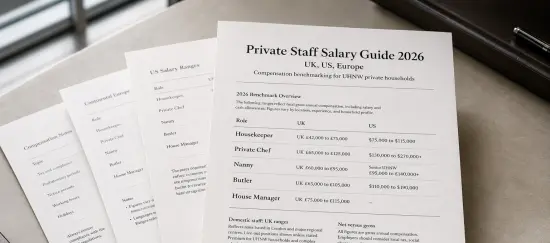
The career outlook for estate managers is highly positive, particularly within the UHNW sector where households require professional management of increasingly complex properties. Salary ranges vary depending on factors such as property size, location, number of residences overseen, and the scope of responsibilities. In general, estate managers can expect competitive compensation packages, with higher salaries awarded to those managing multi-property portfolios, international estates, or large staff teams.

The career path often begins with roles such as personal assistant, house manager, or operations coordinator, before progressing into estate management. With experience, estate managers may advance to positions overseeing multiple estates, providing consultancy services to UHNW families, or even transitioning into corporate property management roles where strategic planning and logistics play a central role.

In terms of long-term opportunities, estate management offers career stability as well as upward mobility. Many estate managers eventually specialize in luxury property consultancy, advising families on staffing, operational efficiency, and estate technology integration. Others build careers in household staffing agencies, training future managers, or taking on regional director roles for families with properties spread across multiple countries.

Ongoing professional development is critical for maintaining competitiveness in the field. Estate managers are expected to keep their skills current through certifications, leadership courses, and mastery of estate management software platforms. As estates adopt more sophisticated systems for budgeting, maintenance scheduling, and staff coordination, candidates with strong digital literacy will remain in highest demand.

Overall, estate management is not just a role but a long-term profession that combines hospitality, operations, finance, and leadership. With growing global wealth and the expansion of UHNW households, skilled estate managers are poised to enjoy both financial rewards and a wide range of professional growth opportunities.

Conclusion & Call to Action

Securing an estate manager position requires far more than simply meeting the job description. Employers in UHNW households and luxury estates are looking for professionals who can demonstrate preparation, foresight, and leadership throughout the interview process. Successful candidates are those who not only understand the operational responsibilities of budgeting, staff management, and property maintenance but who also bring strong interpersonal and communication skills to the role.

Adaptability, discretion, and the ability to lead with confidence remain the hallmarks of effective estate management. In interviews, candidates should focus on illustrating these qualities through real-life examples that highlight both problem-solving and professionalism. The best estate managers are those who combine technical knowledge with the human side of service — delivering operational excellence while fostering trust and maintaining the highest standards of confidentiality.

For individuals aspiring to advance their careers in this field, investing in leadership development, estate management certifications, and networking opportunities will set them apart in an increasingly competitive market. Employers, on the other hand, benefit most from working with candidates who are prepared, strategic, and aligned with the household’s values and long-term vision.

If you are preparing for your next step as an estate manager, or if you are seeking to hire exceptional household leadership, Oplu can help you connect with the right opportunities and talent.

Oplu

Oplu

Oplu Team