The two titles overlap, especially in marketing copy. The roles are different. A Palace Manager runs a residence of significant scale, formal protocol, and (usually) royal, sovereign, or quasi-state context. An Estate Manager runs a private estate or principal residence, typically without the formal protocol layer.
This guide explains what each role actually does, where the line falls, what each is paid in 2026, and which of the two fits your residence.
It is written for principals, sovereign or royal households, and senior household operators considering either appointment.
For the structural overview of the Estate Manager role see Estate Manager for Private Households. For the related role comparisons see House Manager vs Estate Manager vs Head of Household.
For current vacancies see our job board. To discuss a search get in touch.
The headline difference
A Palace Manager runs a residence at scale, with formal protocol, and often in a royal, sovereign, diplomatic, or state-affiliated context. The role typically includes ceremonial elements, formal entertaining at a state level, coordination with security and protection details, and protocol management for state visits and official functions.
An Estate Manager runs a private estate or principal residence at scale, but without the protocol or ceremonial dimension. The role focuses on operational leadership of a residence: staff, contractors, budgets, security, day-to-day running.
The simplest test: if the residence hosts state functions, has a formal protocol officer, or sits in a royal, sovereign, or diplomatic context, the role is Palace Manager. If the residence is a private estate or principal residence without that formal protocol layer, the role is Estate Manager.
What a Palace Manager actually does
A Palace Manager runs the residence as both a working private home for the principal and a formal venue for state, ceremonial, or official functions. The work covers seven threads.
Operational leadership. The full Estate Manager scope: staff, contractors, budgets, security oversight, day-to-day running.
Protocol. Formal protocol for state visits, official functions, and ceremonial events. Liaison with diplomatic, government, and ceremonial offices.
State-level entertaining. Formal dinners, official guest stays, ceremonial functions. Coordination with chefs, butlers, security, and external diplomatic teams.
Security coordination. Working alongside formal protection details, royal protection officers, or government security services. Different scale from a typical Estate Manager security brief.
Heritage and archive. Many palace-grade residences include heritage collections, archives, and historic interiors that require specialist management.
Public-facing dimension. Some palaces and royal residences have a public-facing dimension: visits, openings, ceremonial access. The Palace Manager coordinates these.
Senior household leadership. A Palace Manager typically leads a household team of 30 to 100+ across all functions: housekeeping, kitchen, security, gardens, transport, valet, butler, secretariat.
The role is found in royal residences, sovereign households, government residences, ambassadorial residences at scale, and the largest private palaces in Europe and the Middle East.
What an Estate Manager actually does
An Estate Manager runs a private estate or principal residence at the operational level. The work is part operational leadership, part hospitality, part security, part financial oversight. For the deeper guide see Estate Manager for Private Households.
The role typically covers a household team of 5 to 30, depending on residence scale. The work does not include formal protocol or state-level entertaining.
For the related distinction between Estate Manager, House Manager, and Head of Household see House Manager vs Estate Manager vs Head of Household.
When you need a Palace Manager rather than an Estate Manager
The brief tilts to Palace Manager when one or more of the following are true.
Royal, sovereign, or state context. The residence belongs to a royal household, sovereign principal, or sits within a state structure.
Formal protocol requirement. Regular state-level entertaining, ceremonial events, official visits requiring protocol.
Heritage status. The residence is a listed historic property, includes heritage collections, or has public-facing access.
Scale beyond typical Estate Manager scope. Household teams above 50, multiple ceremonial spaces, formal events as a regular feature.
Specialist security setup. Formal royal protection or government security service coordination.
For most UHNW private residences, even at significant scale, the right role is Estate Manager rather than Palace Manager. Palace Manager is the right role only where the formal protocol or ceremonial dimension is genuinely present.
Compensation in 2026
The two roles sit on different pay scales.
Estate Manager, UK private estate (5 to 15 staff). £110,000 to £180,000 base. Bonus 10% to 25%.
Senior Estate Manager, UK large estate (15 to 30 staff). £160,000 to £250,000 base. Bonus 15% to 30%.
Palace Manager, royal or sovereign household. £200,000 to £450,000+ base, depending on scale and context. Bonus and allowances vary by structure. Sovereign households frequently include accommodation and allowances that change the effective economic position.
Director of Households or Comptroller (the most senior royal household operating role). Bespoke and confidential. Usually structured through advisers.
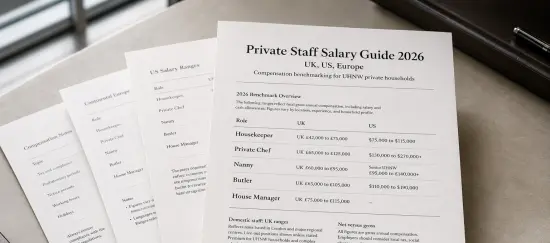
For more on royal and sovereign household hiring specifically see Hiring for Royal and Sovereign Households. For full domestic compensation context see our Private Staff Salary Guide 2026.
What separates strong candidates
For Estate Manager roles, the dimensions are operational judgement, calm under pressure, leadership of mixed teams, and discretion. See Estate Manager Interview Questions for the deeper view.
For Palace Manager roles, two additional dimensions become primary.
Protocol fluency. Formal etiquette, diplomatic protocol, ceremonial conventions. Most strong Palace Managers come from a background in royal household service, diplomatic protocol offices, or formal hospitality at state-level institutions.
Discretion at the highest level. The role is in proximity to information that has political, diplomatic, or state implications. The discretion standard is qualitatively higher than even a senior private estate role.
For more on confidentiality and verification at this level see Confidentiality, NDAs and Background Checks.
How Oplu approaches both roles
Our process is the same in structure but different in detail. For Estate Manager searches we run through our network of placed and known estate managers, interview in depth, and present a small shortlist.
For Palace Manager searches we work through a smaller, more specialist pool, often involving introductions from existing royal household operators, diplomatic protocol officers, or comparable institutions. The brief and the search must reflect the protocol and ceremonial dimension, not just the operational scale.
For more on what a professional engagement looks like see What to Expect When You Engage a Private Recruitment Firm.
For current vacancies see our job board. To discuss a search get in touch.
Further insights from the Oplu series