PRIVATE-ESTATE

Hire Talent

Our exceptional talent sourcing for high-profile individuals, families, private households, and global organizations makes Oplu uniquely suited to support our clients.

Learn More
Submit CV

Hire Private Household & Estate Staff

Bespoke Talent For Bespoke Living

Oplu helps UHNW principals and their representatives hire for lasting success across private households and estates. Our searches are discreet, senior-led, and built to protect confidentiality whilst delivering a decision-ready shortlist. Hiring for private homes is hard for predictable reasons. The environment is intimate, standards are personal, and the cost of a mis-hire lands in the home, not in a boardroom.

Most households do not have the capacity to run a comprehensive search alongside the demands of daily operations. Even when there is an existing team, private hires still require specialist judgement, controlled disclosure, and access to candidates who are not on job boards.

Private household recruitment agency

Oplu is a specialist private household and estate recruitment agency built for precision and discretion, operating across the private client services market. We run searches where the brief is defined by environment, trust, and working pattern, not title. When a mandate is senior or sensitive, we use direct outreach and controlled referral networks rather than open advertising.

When to engage a specialist household recruiter

Time and resource constraints

Running the search internally would consume disproportionate time alongside daily household management. You lack the bandwidth to manage a lengthy, confidential process without disruption.

Confidentiality and disclosure control

A broad search would widen exposure or create noise within the household. You need controlled outreach to passive candidates. The brief is sensitive or the role carries close personal access.

CVs converge and judgement replaces volume

At this level, CVs look the same. A housekeeper CV is a housekeeper CV. What separates candidates is personality, attitude, and how they behave under pressure. That is what we interview for, and it is why clients use us instead of running the search themselves.

Coverage and rota design

You need help structuring coverage models, rota systems, and overtime expectations before approaching candidates. Clients sometimes expect a recruitment fee to deliver the cheapest hire. The fee exists to find the best candidate in the shortest time. If the priority is minimum cost, the search will not deliver what either side needs.

What to prepare before briefing

Briefing checklist: scope, hours, boundaries and working pattern

Before you approach the market, lock these elements:

  • Role scope and non-negotiables for the position

  • Working pattern: live-in or live-out, hours, rota, travel, weekend and holiday expectations

  • Household structure: who else is on the team, who the candidate reports to, who can instruct

  • Residences: how many, locations, seasonal patterns, travel between properties

  • Language, cultural, and presentation requirements where applicable

  • Compensation structure: base, overtime, benefits, accommodation, meals, travel expenses

Stakeholder alignment

In some households, when a principal's spouse does not work, they make the running of the estate their occupation. This creates a dual-authority problem for household staff. We scope reporting lines and decision authority before searching, because this dynamic is the single biggest cause of household staff turnover. Agreement across decision-makers on scope, authority, and working pattern prevents churn.

Confidentiality and privacy considerations

Define what information can be shared, with whom, and at what stage. Agree the disclosure sequence. Clarify any constraints on reference contact or background checks. Decide how candidates learn about the household during the process.

How Oplu runs a search

We begin by scoping the brief properly. We confirm the household environment, working pattern, reporting line, and coverage model. We clarify what matters to the principal versus what has been assumed by the team.

Some clients prefer to start staff on a lower salary deliberately. Not low, but below what they could pay. A high number attracts candidates motivated by money. A reasonable number attracts candidates motivated by the role. The salary rises fast for the right person.

We combine targeted outreach with referral networks. For household roles, we run private recruitment in the true sense: controlled disclosure, direct approaches, and a shortlist built for comparison. We assess candidates through scenario testing and practical exercises where appropriate. In private work, we recommend a paid trial period for most placements. For nannies, housekeepers, and live-in roles, this is standard practice. For PAs and senior household staff, it is increasingly common and we advise it. A week of reality tells you more than three rounds of interviews.

Oplu uses structured shortlisting and discreet referencing. We handle references in the right sequence to protect privacy and gather intelligence that matters. We support offer clarity, trial design, and onboarding alignment.

Briefing checklist summary

Before engagement with candidates:

  • Role scope: title, working pattern, hours, travel

  • Coverage model: live-in or live-out, rota, overtime rules

  • Reporting line and household team structure

  • Confidentiality protocol and disclosure sequence

  • Language, cultural, or presentation requirements

  • Compensation: base, overtime, benefits, accommodation

Aligned stakeholders:

  • Principal or primary decision-maker

  • Spouse or partner where relevant to day-to-day management

  • Existing household manager or estate manager

  • Timeline and availability for interviews and trials

Privacy boundaries:

  • What can be shared in initial approach

  • When and how candidate meets the principal or family

  • Reference protocol and timing

  • Feedback and close-down communication

Next steps

Further reading

Global Reach, Personalised Service

With decades of experience, our talent managers use a bespoke consultation process to connect clients with exceptional candidates. From London and New York to Los Angeles and beyond, our comprehensive global network ensures the perfect match.

At Oplu, we deliver transparency, efficiency, and excellence, saving you time and effort while ensuring your household is in the best hands

Personal support recruitment consultant reviewing household plans with a private estate client in a refined residence.

Personal Support Recruitment

Personal Support staff are the people closest to the principal's daily life. They manage time, logistics, wardrobes, travel, households and the constant stream of requests that define life at the top of a complex private estate. When these roles work well, everything around the principal runs quietly and without friction. Oplu is a specialist personal support staff agency placing Private PAs, Lifestyle Managers, Family Assistants and Wardrobe Managers into UHNW households across the UK and internationally. Every search we run is confidential, scoped to the household and built around the principal's preferences, not a generic job description.

What Personal Support means in a private household

In a corporate setting, support staff follow a structure. Hours are defined, reporting lines are clear and the scope of the role rarely shifts. In a private household, none of that applies. Personal Support in a UHNW context means operating at the centre of someone's life. The work is varied, unpredictable and deeply personal. A Private PA may be managing a renovation one week and coordinating a family holiday the next. A Lifestyle Manager might oversee a principal's social calendar, wellness schedule and travel arrangements simultaneously. A Family Assistant could be liaising with schools, managing children's activities and handling household admin in the same day. These roles demand people who can think ahead, act independently and remain composed when priorities shift at short notice. The best candidates combine operational competence with genuine discretion. They understand that the work is about enabling someone else's life, not building their own profile.

Which Personal Support role do you need?

The four roles within this category overlap in places, but each has a distinct centre of gravity. Choosing the right one depends on what the principal actually needs day to day.
Role Core focus Typical responsibilities Best suited to
Private PA Direct personal and administrative support to the principal Diary management, correspondence, travel booking, errands, household liaison Principals who need a single trusted point of contact for daily logistics
Lifestyle Manager Holistic management of the principal's personal life Travel planning, event coordination, wellness, dining, social calendar, supplier management Principals with complex personal schedules and multiple residences or interests
Family Assistant Practical support for the whole family unit School runs, children's activities, family travel, household errands, light childcare coordination Families with children who need a capable generalist across domestic and logistical tasks
Wardrobe Manager Care, coordination and curation of the principal's wardrobe Garment care, seasonal organisation, styling support, fittings, designer liaison, packing for travel Principals with extensive wardrobes, frequent travel or public-facing commitments
Some households combine elements of these roles into a single position. Others staff each one separately. The right structure depends on the size of the household, the principal's lifestyle and whether other support staff are already in place.

Roles we place

Who we support

Our clients include principals, family offices, estate managers and existing household staff hiring on behalf of a principal. Some are building a support team for the first time. Others are replacing a long-serving PA or restructuring roles after a change in family circumstances, a property acquisition or a relocation. We also work with Family Office PAs and Chiefs of Staff who need to hire Personal Support staff to sit alongside or beneath them in the household structure. Understanding where the new hire fits within the broader team is central to every brief we take.

When to hire permanent vs temporary Personal Support

Not every need calls for a permanent hire. Maternity cover, a trial period before committing to a full-time role, or a short-term project such as a property move or extended travel season may be better served by a temporary placement. Permanent hires work best when the role is well defined, the household is stable and the principal values continuity. The relationship between a principal and their PA or Lifestyle Manager is built on trust, and that takes time. Temporary hires make sense when the brief is fluid, when a household is in transition, or when the principal wants to test the role before committing. A strong temporary candidate can also provide cover while a permanent search runs in the background. We advise on the right approach during the scoping stage. In some cases, a temporary-to-permanent arrangement gives both parties confidence before a long-term commitment is made.

What "good" looks like: skills, mindset and discretion

UHNW personal assistant recruitment is competitive. The best candidates are in demand, and they are selective about where they work. What distinguishes a strong hire from an adequate one is rarely about technical skills alone. Anticipation over reaction. Great Personal Support staff see what is coming before it arrives. They do not wait to be told. They notice patterns, prepare in advance and manage problems before the principal is aware of them. Discretion as default. These roles involve access to financial information, personal relationships, health matters and private correspondence. Candidates who treat confidentiality as something to be reminded of are not the right fit. It must be instinctive. Calm under pressure. Schedules change. Flights are cancelled. Plans shift at the last moment. The right person absorbs this without passing the stress on. They solve the problem quietly and move on. Cultural fluency. Personal Support staff often interact with suppliers, other staff, schools, medical professionals and social contacts on behalf of the principal. They need to represent the household well in every context, adapting their register without losing authority. Longevity mindset. The best hires are not looking for a stepping stone. They are looking for a household where they can do excellent work over several years. That stability benefits everyone.

Common hiring mistakes (and how to avoid them)

Personal support staff recruitment for private estates is different from any other kind of hiring. The mistakes tend to follow a pattern. Hiring on personality alone. Warmth and rapport matter, but they are not a substitute for competence. A PA who is delightful in interview but cannot manage a complex diary will create more problems than they solve. Under-scoping the role. Many principals describe what they want in broad terms. "Someone to help with everything" is not a brief. Without clarity on responsibilities, hours, reporting lines and boundaries, even strong candidates will struggle. Ignoring the household dynamic. A new PA does not operate in isolation. They interact with housekeepers, nannies, drivers and estate staff. If the hire does not fit the existing team, friction follows. We always explore this during the scoping stage. Prioritising pedigree over fit. A candidate who has worked for a well-known family is not automatically right for yours. Household cultures vary enormously. What worked in one setting may not translate to another. Moving too slowly. The best candidates in the UHNW personal support market are not available for long. A drawn-out process with too many interview rounds risks losing the right person to a faster-moving household.

How Oplu works: discreet search, vetting and shortlists

Every search begins with a scoping conversation. We define the role, the household context and the candidate profile before presenting anyone. This is not a box-ticking exercise. We want to understand how the household operates, what the principal values and where previous hires may have fallen short. Candidates are interviewed in depth, with references checked against previous employers. We verify right-to-work documentation and relevant qualifications. Enhanced background checks, including DBS where children are in the household, can be arranged at the client's request. Oplu does not send long shortlists. We present a small number of strong candidates, typically three to five, with clear context on why each one fits. We manage the process through to offer, start date and beyond. Every stage of the search is confidential.

Next steps

Further reading

Learn More
Senior estate management professional reviewing property operations, representing private household and estate management recruitment.

Private Household & Estate Management Recruitment

Oplu is a specialist recruitment agency for ultra-high-net-worth private households and estates. We place estate managers, house managers and the operational staff who keep complex properties running quietly and well. Property and estate management is where the physical reality of wealth meets day-to-day logistics. A principal with multiple residences, seasonal rotations and high standards needs someone who can hold all of it together without requiring attention. That person is either an estate manager or a house manager, depending on scope, and getting the distinction right matters before you begin a search.

Estate management recruitment agency

Most recruitment firms treat estate management as a subsection of hospitality or facilities management. It is neither. The demands of a private household are specific. Discretion is non-negotiable. Reporting lines are often informal. Standards are personal, not corporate. And the consequences of a poor hire are felt daily. Oplu works exclusively in private household and family office recruitment. We understand the dynamics that make these roles succeed or fail. We recruit on proven track record, not potential. When an estate needs a manager who has run a comparable property with comparable complexity, we find that person.

Roles in this category

  • Estate Manager - oversight of property portfolios, capital projects, vendor networks and estate-level operations
  • House Manager - day-to-day running of a single residence or household, managing staff, service standards and logistics

Which hire is right

The distinction between an estate manager and a house manager is not always obvious from outside. Both manage property. Both manage people. The difference is scope and focus.
Estate Manager House Manager
Focus Property portfolio and estate-wide operations Single residence or household operations
Typical mandate Multiple properties, capital projects, land, external vendors, long-term planning Daily household logistics, internal staff, service standards, entertaining
Key difference Operates at portfolio level. Thinks in years. Operates at household level. Thinks in days and weeks.
If you are unsure which role fits your situation, that is precisely where a scoped brief helps. We clarify the mandate before we search.

Who we support

We work with principals, family offices and trusted advisers who are hiring for private households and estates. Our clients include single-residence households in London and New York, multi-property estates across the UK and Europe, and international families with residences in several countries. The common thread is complexity. These are not simple appointments. They require discretion in the search, accuracy in the match and clarity on what the role actually involves before a candidate is ever introduced.

How to scope the hire

In some households, when a principal's spouse does not work, they make the running of the estate their occupation. This creates a dual-authority problem for household staff. We scope reporting lines and decision authority before searching, because this dynamic is the single biggest cause of household staff turnover. Before we begin any search, we work through the brief with you. That means establishing the number and type of properties, the staff structure, the reporting line, live-in or live-out requirements, travel expectations, and the boundaries of the role. A clear brief protects the search and protects the hire. We also establish what the role is not. A house manager who is expected to function as an estate manager will fail. An estate manager hired for a single townhouse will leave. Scope is everything.

What great looks like

The best property and estate managers share certain qualities. They are calm under pressure. They anticipate rather than react. They manage vendors firmly and fairly. They keep a household running without the principal needing to intervene. Vendor management at estate level is reputation management. A poorly managed contractor does not just deliver bad work. They talk. The right hire understands that discretion extends to every tradesperson, supplier and service provider who enters the property. Great also means knowing when to escalate. Not every decision belongs to the manager. The best candidates understand the line between operational authority and principal decision-making, and they respect it consistently.

How Oplu works

We begin with a scoped brief. This is not a job description template. It is a working document built through conversation, covering the realities of the role, the household and the reporting structure. From there, we run a discreet search. We do not advertise senior household roles publicly. We approach candidates directly, with controlled disclosure and careful handling of sensitive information on both sides. Oplu delivers a deliberately small shortlist. Typically three to five candidates, each presented with a written profile covering role-fit, working pattern, compensation expectations and notice period. We support you through interviews, offer negotiation and transition planning.

Next steps

Further reading

Learn More
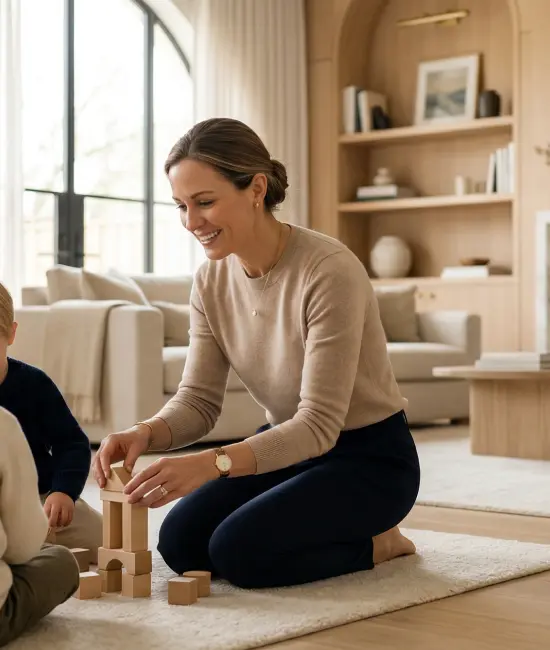
Private estate nanny guiding young children through play-based learning in a refined family home.

Childcare & Education Recruitment

The adults closest to a child in the first two decades of their life shape more than their daily routine. They influence language, values, emotional development and the habits of mind that determine long-term outcomes. For UHNW principals, the decision to bring a childcare or education professional into the household is among the most consequential staffing choices they make. Oplu recruits across the full spectrum of private childcare and education roles, from live-in nannies to specialist tutors, for principals across the United Kingdom, the United States and internationally. Every candidate we place has been assessed for professional competence, temperament, safeguarding credentials and the particular qualities private household work demands.

Childcare & education hires: when to bring in specialist support

Private households do not always fit the standard employment model, and the trigger points for specialist recruitment reflect that. The household is growing. A new child, an expanding family or the birth of twins creates demand that existing staff cannot absorb without a dedicated childcare hire. Existing arrangements are informal. Many principals begin with ad hoc arrangements and reach a point where inconsistency becomes a problem. A vetted, permanent hire brings structure, continuity and accountability. Travel is a constant. Principals who move regularly between properties, across borders or on extended trips need childcare professionals who can travel as a matter of course, not as an exception. Education is becoming a priority. As children move into school-age years, families often want to supplement formal education with in-house tutoring, language instruction or a governess who can manage the academic dimension of the child's development directly. Discretion has become non-negotiable. As children grow and social exposure increases, so does the risk of information reaching the wrong people. A principal who has relied on informal carers often reaches a natural point where the professional bar must rise. A permanent member of staff is leaving. Transition periods around nanny departures require careful management, particularly where children have formed strong attachments.

Roles we recruit

Oplu places the following childcare and education professionals for private households and estates.
  • Live-in Nanny. Resident childcare within the family home, available for full-time schedules including early mornings, evenings and flexible coverage.
  • Live-out Nanny. Professional daily childcare without residential arrangements. Suited to households with clear working hours and stable routines.
  • Rota Nanny. Two nannies working in rotation to provide consistent, uninterrupted coverage. Standard in households with complex schedules or frequent travel.
  • Travelling Nanny. A nanny employed specifically for travel, or a generalist nanny whose role includes regular international movement.
  • Temporary Nanny. Short-term or emergency placements for periods of transition, holiday cover or parental leave.
  • Security Nanny. Nannies with verified close protection or security training, for principals where child safety requires a combined skill set.
  • Manny. Male nannies, recruited for households where a male childcare professional is preferred for cultural, practical or role-model reasons.
  • Governess / Governor. Educationally qualified professionals managing the academic and developmental programme within the household.
  • Maternity Nurse. Specialist support for the newborn period, typically engaged from birth for six to twelve weeks.
  • Newborn Care Specialist. The US equivalent of a maternity nurse, focused on sleep training, feeding and the structured establishment of newborn routines.

Role differences: nanny vs governess / governor vs tutor

These three roles are frequently conflated, and the confusion leads to mismatched hires.
Factor Nanny Governess / Governor Private Tutor
Primary focus Care and daily routine Education and development programme Specific subject or academic outcome
Qualifications Childcare, NNEB, CACHE, first aid Teaching qualification, degree required Degree or postgraduate in subject area
Age range Newborn to early teens Typically 3 to 16 Any age
Household presence Full-time, often live-in Full-time, structured hours Part-time, sessional
Scope Feeding, bathing, activities, school runs Curriculum design, structured learning, educational oversight Subject tutoring, exam preparation
Relationship to school Supplements or replaces Often replaces, manages home-schooling Supplements
Travel Common Moderate Occasional
Decision framework. If the primary need is safe, warm, consistent daily care for children under ten, a nanny is the right hire. If the family is pursuing a structured academic programme, homeschooling or wants an educationally qualified adult managing their child's development full-time, a governess or governor is more appropriate. If the need is specific subject support alongside existing formal schooling, a tutor is the correct fit. Many households run all three in parallel.

Common hiring mistakes in private households

Hiring on personality alone. Warmth and rapport with children are necessary but not sufficient. Qualifications, safeguarding records, references and background checks cannot be skipped because a candidate presents well at interview. Under-specifying the role. Without a clear job description, a nanny hired for two children ends up managing three, covering for absent housekeepers and travelling internationally with no adjustment to terms. Poorly defined roles create resentment and attrition. Skipping the working trial. No interview process, however thorough, replicates the experience of a candidate working in the household. A paid trial period is standard at this level. Prioritising experience over fit. A nanny with ten years at another UHNW household may be technically excellent but entirely wrong for the culture, pace or parenting philosophy of a new principal. Neglecting the candidate's perspective. Strong candidates at this level have choices. Principals who approach the hiring process without thought to what they are offering, including clarity, fair terms and a professional environment, will lose the best people to other households.

What great looks like

The strongest childcare and education professionals in private household service share a set of defining characteristics that go beyond their formal qualifications. They read the household. They understand the dynamics between family members, anticipate what is needed before it is asked and operate with a degree of intuition that cannot be taught. They protect the children without crowding them. Good childcare professionals create secure environments that allow children to take age-appropriate risks, develop independence and experience natural consequences. They communicate with the principal clearly and without drama. Whether escalating a concern, reporting on a child's development or navigating a scheduling conflict, they are direct and calm. They hold the boundary between professional and personal. Long-term household placements create genuine affection. The best professionals understand that this affection exists within a professional relationship, not instead of one. They maintain absolute discretion. The details of a principal's household, schedule, guests and finances are never discussed outside the home.

How Oplu works

Our process begins with a structured briefing. Before any search activity begins, we develop a thorough understanding of the household: its composition, routines, travel patterns, any existing staff, the principal's parenting philosophy and the specific experience required of the candidate. We then conduct a targeted search across our active network and, where required, proactively approach candidates who are not actively seeking new roles. Every candidate we present has been interviewed in depth, their references verified and their safeguarding credentials confirmed. Shortlists are presented in a structured format covering professional background, personal profile, relevant scenarios and our assessment of fit. We facilitate working trials and are available throughout the offer and onboarding process. We maintain confidentiality at every stage. Candidates are not told who the principal is until trust has been established and a shortlist position confirmed.

Next steps

The most effective starting point is a conversation. If you are ready to begin a search, or want to think through which type of childcare or education professional best fits your household's needs, contact Oplu directly. If you are not yet certain which role is right, the pages linked below provide detailed guidance on each position, including when to hire, what to look for and what a competitive package looks like.
Back: Private Households & Estates | Hire Hub

Learn More
Private chef plating a gourmet dish in a luxury marble kitchen with soft warm lighting.

Private Chef Recruitment

The decision to bring a chef into a private household is rarely about convenience alone. It reflects a particular standard of living, one where nutrition, presentation, discretion and personal taste converge in the most intimate of settings: the family table. Whether a principal requires daily meal preparation for a young family, Michelin-level entertaining for guests, or precision nutrition for athletic performance, the right chef transforms the rhythm of a home. Oplu's Private Households and Estates division recruits chefs across the full spectrum of private culinary roles. Each placement is shaped by the household's culture, dietary requirements, entertaining schedule and travel patterns. We work only with candidates whose technical ability, temperament and discretion have been thoroughly assessed.

Private Chef Recruitment Agency

Finding a chef who can cook to a high standard is not the difficult part. The challenge lies in identifying someone who can sustain excellence within the particular pressures of a private household: shifting schedules, evolving dietary preferences, extended travel, formal entertaining at short notice and the constant requirement for confidentiality. Oplu operates as a specialist private chef recruitment agency, placing culinary professionals in UHNW households, estates, yachts and multi-property portfolios across the United Kingdom, the United States and internationally. We evaluate not only culinary range and training but also adaptability, communication style and capacity to work within a broader household team. We place chefs on a permanent, temporary and rotational basis. Every candidate undergoes reference verification, right-to-work checks and, where required, enhanced background screening.

Roles We Place

The term "private chef" covers a broad range of specialisations. Each serves a distinct purpose, and the right choice depends on the household's priorities, scale and lifestyle.
  • Private Chef. The foundational role. Daily meal preparation, dietary management, shopping, menu planning and informal entertaining for a single household.
  • Head Chef. A senior culinary leader who manages a kitchen team, oversees sous chefs and runs large-scale entertaining programmes. Appropriate for estates and households with significant hospitality demands.
  • Nutritional Chef. A chef with specialist training in personalised nutrition, longevity protocols, allergy management and wellness-led menus. Often works in collaboration with nutritionists or physicians.
  • Pro-Performance Chef. Focused on elite athletes and high-performance principals. Delivers macro-tracked, periodised nutrition aligned with training cycles, competition preparation and recovery.
  • Travelling Chef. Accompanies the principal between residences, yachts and holiday properties. Requires adaptability across kitchens, local sourcing and maintaining dietary consistency in varied locations.

Role Comparison

Aspect Private Chef Head Chef Nutritional Chef Pro-Performance Chef Travelling Chef
Primary focus Daily family meals and entertaining Kitchen team leadership and large-scale events Wellness-led, personalised nutrition Athletic performance and macro precision Multi-location culinary consistency
Team management Typically sole chef Manages sous chefs and kitchen staff Usually sole chef, collaborates with health professionals Usually sole chef, liaises with trainers and nutritionists Usually sole chef, may manage local kitchen assistants
Entertaining scale Intimate to mid-scale Large-scale, formal and frequent Intimate, health-focused Rarely a primary focus Variable, adapts to location
Specialist knowledge Broad culinary range Menu engineering, team management, large-event logistics Clinical nutrition, dietary science, longevity protocols Sports science, periodisation, competition nutrition International sourcing, kitchen adaptability, logistics
Travel requirement Occasional Rare Occasional Moderate to frequent (competition travel) Constant
Typical salary (UK) £50,000 to £130,000+ £60,000 to £150,000+ £45,000 to £100,000 £45,000 to £90,000 £55,000 to £120,000+
Typical salary (US) $95,000 to $200,000+ $100,000 to $220,000+ $80,000 to $160,000 $80,000 to $150,000 $90,000 to $180,000+

Who We Support

Oplu's private chef recruitment services are used by principals, family offices, estate managers and personal assistants across a range of household structures.
  • Single-residence UHNW families seeking a chef for daily meal preparation and regular entertaining.
  • Multi-property households requiring a chef who can travel or rotate between residences.
  • Estates with existing household teams, where the chef must integrate with housekeepers, butlers, estate managers and other staff.
  • Yacht and villa owners who need a chef comfortable with confined kitchens, remote provisioning and extended travel.
  • Athletes and high-performance individuals whose dietary requirements are clinically prescribed and performance-linked.
  • Principals with complex dietary needs, including autoimmune conditions, allergies, religious requirements or longevity-focused protocols.

How to Scope the Hire

Before beginning a search, it is worth clarifying a few foundational questions. These shape the brief and determine which type of chef role is most appropriate.
  1. What is the household's daily dining pattern? Consider the number of people eating, the frequency of formal entertaining and whether meals need to be prepared for staff as well as the principal.
  2. Are there specific dietary requirements? Clinical conditions, religious observances, performance goals and personal preferences all influence the candidate profile.
  3. Will the chef travel? If the principal moves between properties or travels frequently, a travelling chef or a rotation arrangement may be needed.
  4. Is there an existing kitchen team? If yes, the hire may need to be a Head Chef capable of managing others. If no, a sole-charge Private Chef is likely the right fit.
  5. What level of entertaining is expected? Occasional suppers for six require a very different skillset from formal dinners for forty.

What Great Looks Like

An outstanding private chef does more than produce excellent food. They anticipate preferences, manage budgets without being asked, source ingredients with care and adapt seamlessly when plans change at the last moment. They communicate clearly with the household team, respect boundaries and maintain absolute discretion about the family's habits, guests and personal life. The best candidates bring a combination of formal training, varied professional experience and the personal maturity to thrive in a domestic setting. They are self-motivated, organised and calm under pressure. They view their role not as a series of meals to be prepared but as a contribution to the household's overall wellbeing.

How Oplu Works

  1. Consultation. We begin with a detailed discussion to understand the household's needs, culture, dietary requirements and expectations. This may involve conversations with the principal, their PA, estate manager or family office.
  2. Search. We draw on our existing network and conduct targeted outreach to identify candidates whose skills, experience and temperament match the brief.
  3. Vetting. Every candidate undergoes structured interviews, reference verification, right-to-work checks and, where appropriate, enhanced background screening. We assess culinary ability through practical evaluation where possible.
  4. Shortlist. We present a curated shortlist, typically three to five candidates, accompanied by detailed profiles and our assessment of each candidate's fit.
  5. Trial and placement. We facilitate trial periods, negotiate terms and support the onboarding process. Post-placement, we remain available to both parties.

Next Steps

If you are considering hiring a private chef, or if you are unsure which type of culinary role best suits your household, we welcome a confidential conversation. Contact Oplu to discuss your requirements, or explore current opportunities if you are a chef seeking your next private role.

Further Reading

Learn More
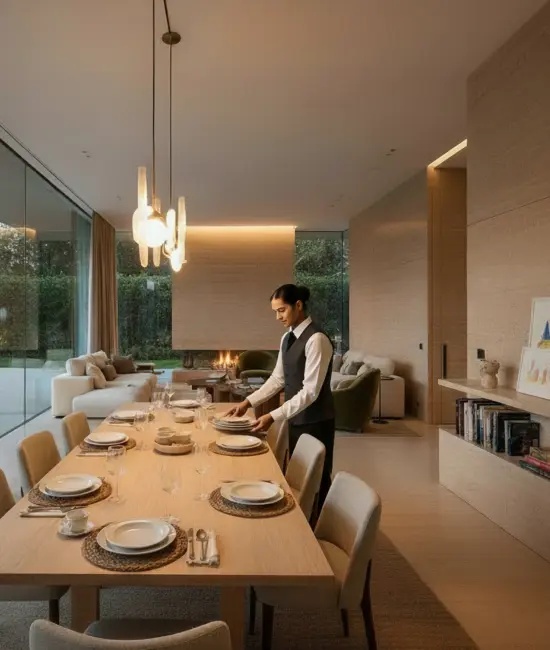
Domestic service staff member setting a formal dining table in a modern private residence.

Domestic & Service Staff Recruitment

Oplu is a specialist recruitment agency for private households and estates seeking domestic and service staff. We place candidates into roles where discretion, competence and character matter more than a conventional CV. Our clients include families, principals and estate offices across the UK and internationally. Hiring domestic staff well requires more than matching a job title to a candidate list. It means understanding how a household runs, what the principal expects and where a new hire will sit within an existing team. The brief has to reflect that before a search begins.

Domestic and service staff recruitment agency

Private households need staff who can work independently, adapt to changing routines and maintain high standards without constant oversight. The roles vary widely in scope. A housekeeper managing a single London residence faces different demands from one overseeing a country estate with seasonal occupancy. A chef cooking daily family meals works to a different rhythm than one preparing for regular entertaining. Oplu works across the full range of domestic and service staff positions. Each search is scoped around the specific household, not a generic job description.

Roles we place

Which hire is right for your household

Not every household needs every role. Some need a single housekeeper who can manage the entire property. Others need a full team with clearly defined responsibilities. The table below outlines the core domestic roles and where they sit.
Role Focus Typical mandate Key difference
Housekeeper Property care, organisation, daily household management Cleaning, laundry, stock management, supplier liaison Manages the physical environment and day-to-day running of the home
Butler Front-of-house service, hospitality, household coordination Table service, guest management, wine cellar, staff oversight Sets the standard of service and acts as the principal's point of contact
Chef Food preparation, menu planning, dietary management Daily meals, entertaining, sourcing, kitchen management Works to the family's tastes and schedule, often independently
Chauffeur Transport, vehicle management, route planning School runs, airport transfers, event logistics, fleet care Combines driving skill with discretion and flexible availability
A household couple can cover two of these areas in a single live-in arrangement. This is common in smaller properties or secondary residences where a full team is not justified.

Who we support

We work with principals, family offices, estate managers and private PAs. Some clients are building a household team for the first time. Others are replacing a long-serving member of staff or restructuring roles after a property change. UK domestic staff salaries sit above most of Europe. Cross-border mobility is limited, so the UK market sets its own floor. Clients hiring in London or the Home Counties should expect salary benchmarks that reflect this reality.

How to scope the hire

The brief is the foundation of a good hire. Before starting a search, it is worth defining a few things clearly. Hours and structure. Is this a live-in or live-out role? What are the core hours? Is flexibility required for travel, entertaining or seasonal changes? Responsibilities. What does the role actually cover day to day? Where does it overlap with other staff? Where are the boundaries? Experience level. Does the household need someone senior who can run the operation, or someone earlier in their career who will grow into the role? Salary and package. In domestic roles, candidates talk about net salary. Clients should care about gross, because that is what they actually pay. The gap between the two is where most budget surprises sit. Getting this right at the start avoids difficult conversations later. Some clients prefer to start staff on a lower salary deliberately. Not low, but below what they could pay. A high number attracts candidates motivated by money. A reasonable number attracts candidates motivated by the role. The salary rises fast for the right person.

What great looks like

The best domestic staff share a few qualities. They anticipate rather than react. They maintain standards without being asked. They understand that the household is someone's home, not a workplace in the conventional sense. A housekeeper can start on a salary that matches a first-year analyst at a City investment bank. The difference is that the analyst's salary doubles in three years. The housekeeper's barely moves. This means retention depends on more than pay. It depends on the working environment, the relationship with the principal and the clarity of the role. Great staff stay because the role is well defined, the household is well run and the expectations are fair. Getting the hire right at the start is what makes that possible.

How Oplu works

Every search begins with a scoping conversation. We define the role, the household context and the candidate profile before presenting anyone. Candidates are interviewed, referenced and assessed against the specific brief. Oplu does not send long shortlists. We present a small number of strong candidates, typically three to five, with clear context on why each one fits. We manage the process through to offer, start date and beyond. Our approach is confidential throughout.

Next steps

Further reading

Learn More

We are Here to Help


Call Us
Write to Us

Testimonials

We worked with Oplu on a Travelling Nanny hire. They are exceptionally thorough and discreet. They took time to understand the principal’s expectations and the reality of the household, then screened properly before presenting candidates. The process was clear and professional.

Private PA

UHNW International Family, Florida

Oplu helped us hire a Private Chef. They understand Private Estates hiring is about trust and fit, not just experience. They assessed capability and character properly and delivered a shortlist that was genuinely well matched.

House Manager

UHNW Family, Monaco

We hired a House Manager through Oplu. The process was handled with real care and confidentiality. Communication was tight, logistics were managed smoothly, and only credible, properly briefed candidates were introduced.

Chief of Staff

UHNW Family, London

Our Process

  • Onboarding

    Share your brief, and together we’ll define the perfect candidate profile to meet your needs.

  • Research

    Leveraging our expertise, networks, and market knowledge, we source exceptional talent aligned with your brief.

  • Management

    We handle the entire process, submitting candidates, managing queries, conducting interviews, and coordinating trials, all powered by cutting-edge recruitment technology.

  • Securing The Hire

    Our team supports you through the job offer and negotiations, ensuring a seamless and successful hire.

Hire Private Household & Estate Staff FAQs

A housekeeper manages the daily running of the home: cleaning standards, laundry, inventory, and household routines. A house manager oversees the household team and coordinates across vendors, maintenance, and service delivery. An estate manager operates at a higher level, managing multi-residence operations, budgets, capital projects, and external contractors. The right hire depends on how many residences you have, how large the team is, and what level of authority the role requires.