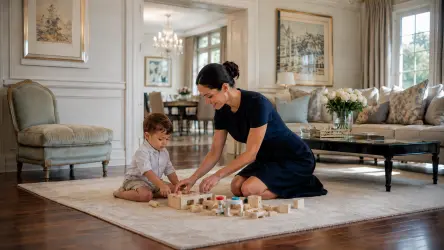
A nanny is a professional childcare provider in a private household, responsible for the day-to-day care, education, and development of children. A manny is a male nanny, doing the same job. Both are part of a broader spectrum of UHNW childcare roles that includes Norland nannies, governesses, tutors, and travelling nannies.
This article gives the working definition, the modern variations of the role, and where each fits in a UHNW household. For broader staffing context see Private Staff Salary Guide 2026. For the candidate-side career path see How to Become a Nanny.
For current vacancies see our job board. To discuss a search get in touch.
The working definition
A nanny is a full-time childcare professional in a private household. They are responsible for one or more children, typically from infancy or early childhood through primary school years, sometimes longer. The work covers five threads.
Daily care. Routine, meals, sleep, hygiene, age-appropriate activities, school runs, transitions through the day.
Development. Age-appropriate learning, language development, motor skills, social skills, emotional regulation. Strong nannies actively support development rather than simply supervising.
Health and safety. First aid, safeguarding, medication management where required, immediate response to emergencies, ongoing health awareness.
Discipline and boundaries. Holding the household's agreed approach to discipline. Consistency between parents and nanny on standards and expectations.
Family integration. Working closely with parents, household staff, and external carers (school, doctors, activity providers) to maintain consistency in the child's experience.
The nanny is the most personal household role after the principal's immediate family. The trust required is qualitatively different from any other staff hire.
Manny: the male nanny
A manny is a male nanny. The role is identical in scope and responsibility to a nanny. The terminology has emerged because some families specifically seek a male childcare provider, particularly for older boys, for activity-led caregiving (sport, outdoor activities), or for households that value the additional male role model presence.
The pool is smaller than the nanny pool. Strong mannies have the same qualifications and training as strong nannies, often coming from physical education, sports coaching, teaching, or military backgrounds combined with formal childcare training.
The childcare role spectrum in UHNW households
The category includes several distinct titles, each with a specific scope.
Nanny. The standard childcare role in a private household. Full-time daily care.
Manny. Male nanny, same scope.
Maternity Nurse / Newborn Care Specialist. Specialist role for the first few months after birth. Sometimes extends through the first year. Highly specialised in newborn sleep, feeding, and early development.
Norland Nanny. A graduate of Norland College in Bath, the most prestigious childcare training institution in the UK. The Norland qualification is widely recognised in UHNW households globally and commands a meaningful premium. Norland nannies are formally trained in childcare, child development, security awareness, and discreet professional service.
Travelling Nanny. A nanny who travels with the family between residences and on holiday. Typically employed full-time with travel expectations explicit in the contract.
Live-In Nanny. A nanny who lives at the residence (in dedicated accommodation, usually a self-contained flat or annex). Common in country households and for parents with intensive schedules.
Live-Out Nanny. A nanny who works defined hours and returns to their own home. More common in London and urban households.
Governess. A more senior childcare and education professional, typically for older children. Includes formal teaching, often working alongside or replacing a nanny as children move through primary school years.
Private Tutor. Specialist educational role, often working alongside the school's curriculum. Typically a qualified teacher rather than a primary childcare provider.
Mother's Help / Mother's Aide. A supporting role, less qualified than a nanny, often used in household teams alongside a senior nanny. Common in larger households with multiple children.
For more on Norland and governess specifically, see How to Become a Nanny.
What a UHNW family typically needs
Three patterns are common in UHNW households.
Single child or young family. A senior nanny (often Norland-trained) full-time, sometimes with a Maternity Nurse for the first three to six months.
Multiple children at different ages. A senior nanny plus a junior nanny or mother's help. Sometimes a governess for older children alongside the nanny.
Multi-residence travelling family. A travelling nanny full-time, plus local support nannies at each main residence. The travelling nanny holds continuity for the children across geographies.
The right structure depends on the children's ages, the family's lifestyle, and the household scale. Hiring patterns evolve as the children grow.
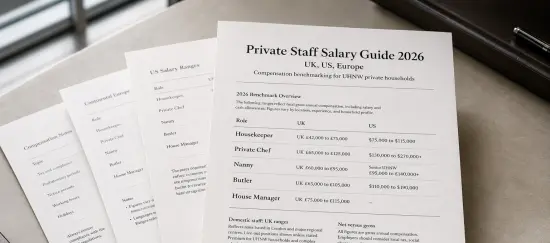
What a nanny is paid in 2026
UK ranges from Oplu placement experience.
Junior nanny / mother's help. £35,000 to £50,000 base. Live-in arrangements common.
Mid-level nanny. £45,000 to £65,000 base.
Senior nanny. £55,000 to £80,000 base. Bonus 5% to 15%.
Norland nanny / specialist senior nanny. £75,000 to £110,000 base. Bonus 10% to 20%.
Travelling nanny / multi-residence senior. £80,000 to £140,000 base. Travel paid.
Governess. £75,000 to £120,000 base, depending on educational specialism.
US ranges sit roughly 30% to 50% above UK at comparable scale. Live-in arrangements typically include accommodation as part of the package.
For full domestic compensation context see our Private Staff Salary Guide 2026.
Read next
For the candidate-side career guide see How to Become a Nanny.
For travelling roles and multi-residence childcare see Travelling Positions in Private Households.
For confidentiality and verification at this level see Confidentiality, NDAs and Background Checks.
For current vacancies see our job board. To discuss a search get in touch.
Further insights from the Oplu series