A private chauffeur in a UHNW household is one of the most personal hires in private service. The chauffeur sees the principal at moments family members do not. They handle the people the principal cares about most. They are present during sensitive conversations, difficult days, and family transitions. The cost of a mis-hire is felt every day.
This guide explains how to scope a chauffeur search, where strong candidates come from, the interview and trial process, what to pay, and the patterns that drive retention or departure.
It is written for principals, House Managers, Estate Managers, and Chiefs of Staff hiring or upgrading the driving function.
For the role overview see Private Chauffeur for UHNW Families. For current vacancies see our job board. To discuss a search get in touch.
Before you start the search
Five structural questions to settle before any agency is engaged. Skipping these produces misaligned shortlists and slow searches.
Coverage. Single chauffeur or part of a fleet? If part of a fleet, what is the structure: head chauffeur with rotating drivers, or independent chauffeurs each assigned to a family member?
Hours and on-call. Standard daytime hours, 24/7 availability, principal-defined? An honest answer here drives compensation and candidate expectations. The hardest searches to run are those where the principal will not commit to a coverage model.
Travel. UK only, European, international, multi-residence? Travel-heavy roles require a different candidate profile and command a meaningful premium.
Security profile. Civilian chauffeur with situational awareness, security-aware chauffeur with formal training, or formal Close Protection Officer with driving role? The answer changes the candidate pool, the salary, and the interview process completely.
Vehicle and fleet. Specific vehicles, EV familiarity, performance car familiarity, light armoured vehicle experience. Specifying this narrows the candidate pool to those with the right technical fit.
For more on the structural questions to answer before any senior household hire see Common Hiring Mistakes in Private Offices.
Where strong candidates come from
Several pipelines feed the senior chauffeur pool.
Existing private households. Direct moves between households. The most common source for senior chauffeurs. References travel through the principal's network.
Corporate executive driving. Drivers from senior corporate roles transitioning to private. The driving skill transfers; the principal-relationship dynamics are different and need to be tested.
Military and police backgrounds. Strong source for security-aware and formally trained candidates. Many move into private chauffeur roles with security training.
Close Protection Officer transitions. Some CPOs add driving as part of their portfolio. Premium candidates with formal security training plus driving skill.
Specialist driving schools. Bondurant, advanced driving programmes, defensive driving schools. Rarely a primary source but a useful filter for technical skill.
Hospitality and service backgrounds. Less common but occasional. Drivers transitioning from hotel transport or VIP airport services.
The strongest candidates have several years in private service plus formal driving qualifications (RoSPA, IAM, defensive driving). Senior chauffeurs in higher-risk principal households also typically have security training.

The interview and trial process
A serious chauffeur search runs through three or four stages.
First-stage interview with the recruiter. Sixty to ninety minutes. Driving track record, references, behavioural fit, security profile. Strong candidates filtered for discretion and presence.
Driving assessment. Practical assessment of driving skill: smooth acceleration and braking, anticipatory road reading, parking accuracy, comfort in the relevant vehicle types. Can be done by the recruiter, by an external advanced driving instructor, or in the household's own vehicle with the head chauffeur or House Manager observing.
Interview with the House Manager or senior operator. Working style, fit with the household, on-call expectations, scope alignment.
Interview with the principal. Often the deciding stage. Frequently informal. Tests behavioural fit and presence in real interaction.
Trial. One to three days driving the principal at full pay. Tests calibration to the principal's preferences, route knowledge, and integration with the existing team.
References run in parallel and are taken directly with previous principals or House Managers, not generic agency references. Background verification is standard at this seniority. For more see Confidentiality, NDAs and Background Checks.
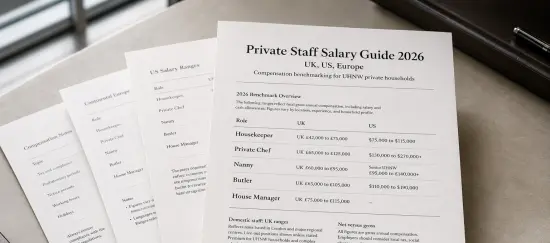
Compensation in 2026
UK ranges from Oplu placement experience.
Junior or mid-level private chauffeur. £42,000 to £62,000 base.
Senior private chauffeur, principal household. £60,000 to £85,000 base. Bonus 5% to 15%.
Head chauffeur, multi-driver fleet. £75,000 to £105,000 base. Bonus 10% to 20%.
Travelling chauffeur, principal-with-international-residences. £80,000 to £120,000 base. Travel and accommodation paid.
Chauffeur with formal security qualifications. Premium of 15% to 30% over equivalent civilian roles.
US ranges sit roughly 30% to 50% above UK at comparable scale. Middle East roles are typically structured net of tax with accommodation provided.
For full domestic compensation context see our Private Staff Salary Guide 2026. For why generic published data for these roles is unreliable see Why Published Salary Data Is Misleading.
Common mistakes when hiring a chauffeur
Five patterns produce expensive hires that do not last.
Hiring on driving alone. Driving skill is necessary but not sufficient. The candidate who cannot read the principal's mood, anticipate plans, or hold a confidence will not last regardless of how well they drive.
Under-scoping security. Lower-risk principals scope a civilian chauffeur and discover, six months in, they need security awareness they did not specify. Higher-risk principals scope a security-trained chauffeur but the brief does not align with the actual residence security setup. Scope security explicitly before the search starts.
Skipping the trial. The trial reveals what interviews cannot: how the candidate calibrates to the principal's actual driving preferences, how they integrate with the existing team, and how they handle the rhythm of an actual day. Skipping the trial drives a meaningful share of chauffeur placements that fail in the first three months.
Under-paying. Senior chauffeurs in serious UHNW households are paid more than published benchmarks suggest. Households that anchor on generic salary data underpay and lose strong candidates to competing households.
Failing to scope on-call expectations. The biggest source of friction in chauffeur roles. The candidate who agrees to "occasional evenings" and finds themselves on-call for every weekend will leave. Be honest about the actual coverage required.
For more on common structural hiring mistakes see Common Hiring Mistakes in Private Offices.
Retention: what makes chauffeurs stay
Private chauffeurs leave for predictable reasons. Knowing them helps you keep the strong ones.
Clear coverage and time off. Predictable on-call patterns, real days off, real holiday entitlement honoured. Chauffeurs who never get genuine downtime leave within eighteen months.
Respect from the principal. Daily small courtesies. Acknowledgement of long hours. Reasonable handling of last-minute changes. The chauffeur who feels treated as part of the household stays. The one who feels treated as a service eventually leaves.
Vehicle condition and budget. A chauffeur who drives a well-maintained, pleasant vehicle for the principal is in a different daily experience to one driving a poorly maintained one. Investment in the vehicle is investment in the role.
Clear authority and limits. Knowing what the chauffeur can and cannot decide on their own (route changes, schedule variations, security responses). Clear authority is a retention factor. Constant micromanagement drives departure.
Compensation and progression. Annual reviews honoured, market-rate bonuses paid, progression to head chauffeur or senior fleet roles where the household scale allows.
For more on the broader question of retention and senior household hiring see Common Hiring Mistakes in Private Offices.
How Oplu approaches chauffeur searches
Our process matches the seniority of the role. We work through the brief in detail with the principal, House Manager, Estate Manager, or Chief of Staff. We run the search through our network of placed and known chauffeurs across private households, security backgrounds, and corporate driving. We interview every candidate ourselves before any reach the principal.
For higher-risk principals, we coordinate the search with whichever security firm holds the protection function, so the chauffeur fits into the broader security setup.
Shortlists are deliberately small: three to five candidates for most senior chauffeur searches. Each comes with a written profile covering driving experience, references taken, security profile, working style, and our honest read on fit.
For more on what a professional engagement looks like end to end see What to Expect When You Engage a Private Recruitment Firm.
For current vacancies see our job board. To discuss a search get in touch.
Further insights from the Oplu series