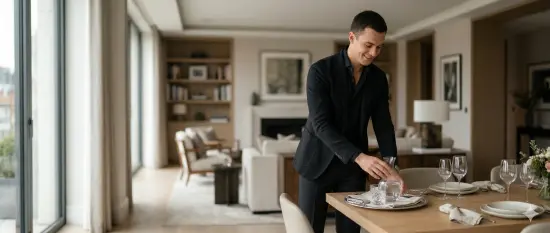
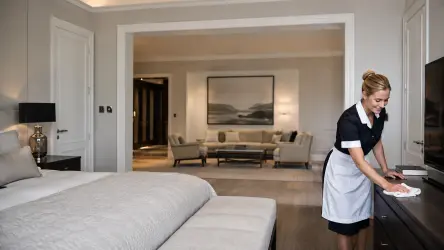
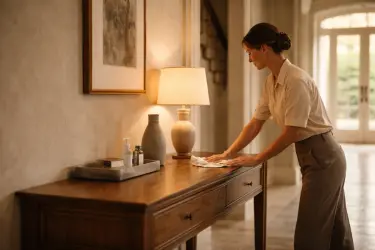
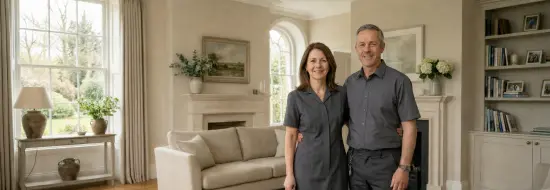
A domestic couple is two people, usually partners, who work together to run a private household. One typically manages the interior (cooking, housekeeping, laundry, wardrobe care) while the other handles the exterior and logistics: grounds maintenance, driving, property upkeep, security oversight. The division varies by household, but the principle is the same: one unit covers what would otherwise require three or four separate hires.
The arrangement works because of trust. A domestic couple lives on site, knows the property intimately, and operates as a self-managing team. They do not need daily instruction. In households where the principal travels frequently or splits time between residences, a domestic couple provides continuity without the overhead of a larger staff structure.
Who hires domestic couples?
The role suits a specific type of household. Country estates with a single principal or small family. London townhouses where space limits staff numbers. Secondary residences that need year-round caretaking. International properties where the owner is present only part of the year.
What these households share is a preference for discretion and simplicity. Rather than managing multiple staff relationships, the principal deals with one team. The couple coordinates between themselves. The household runs quietly.
Domestic couples are also common in semi-retired or downsizing households, particularly families who previously employed larger teams but now want a leaner operation without sacrificing standards.
What does a domestic couple actually do?
The scope depends on the property and the principal's lifestyle, but a typical split looks like this:
One partner (interior focus):
Cooking: daily meals, occasional entertaining, dietary management
Housekeeping: cleaning, laundry, ironing, bed-making, wardrobe care
Shopping and provisioning: groceries, dry cleaning, household supplies
Guest preparation: rooms, flowers, welcome provisions
Household administration: managing deliveries, scheduling tradespeople
The other partner (exterior and logistics):
Grounds and garden: mowing, planting, hedge maintenance, seasonal upkeep
Property maintenance: minor repairs, liaising with contractors, overseeing works
Driving: school runs, airport transfers, errands
Security: locking up, alarm systems, CCTV monitoring
Vehicle care: cleaning, servicing, MOT scheduling
In practice, most couples flex across both lists depending on the day. A formal dinner might need both in the kitchen. A property emergency pulls both outside. The value is in adaptability rather than rigid job descriptions.
Domestic couple vs hiring separate staff
The trade-off is straightforward. A domestic couple costs less than hiring a housekeeper, a gardener, a cook and a driver separately. They also require less management and fewer bedrooms. The downside is capacity. A couple cannot cover the same volume as four specialists working full days.
For larger estates with frequent entertaining, multiple properties, or young children, separate staff or a larger team is usually necessary. For households that need reliable, high-quality daily management without complexity, a domestic couple is often the better fit.
Live-in arrangements
Almost all domestic couple roles are live-in. The property typically provides a self-contained flat or cottage with a separate entrance, own kitchen, and living space. This is not optional. Experienced couples will not accept a single room with shared bathroom. The quality of accommodation directly affects how long the couple stays.
Couples expect their own space to be genuinely private. The principal should not enter unannounced. Days off should be uninterrupted. The couple lives on site, but the boundary between work and rest needs to be clear and respected.
Salary and package
United Kingdom:
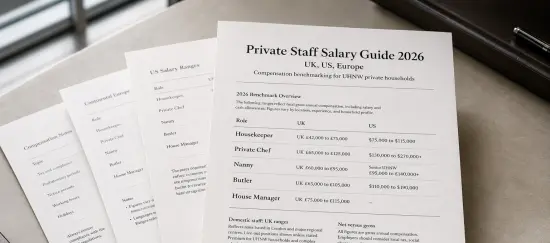
Combined salary: £60,000-£100,000 per annum (net of accommodation)
Higher end for London, large estates, or roles requiring specialist skills (formal service, silver care, fine dining)
Accommodation, utilities, and council tax typically provided
Vehicle often included for work use
United States:
Combined salary: $100,000-$180,000 per annum
Higher in New York, Hamptons, Palm Beach, Aspen
Live-in accommodation standard
Health insurance and PTO expected
These figures assume a standard five-day week with flexibility for occasional evenings or weekends around entertaining. Roles requiring seven-day coverage or managing multiple properties sit above these ranges.
What makes a domestic couple successful?
The couples who last in private households share a few traits. They are self-starters who do not need to be told what needs doing. They communicate clearly with each other and with the principal. They maintain professional boundaries even when living on site. They take pride in the property as though it were their own, without overstepping.
The biggest failure point is misaligned expectations. A principal who expects formal butler-level service from a couple hired for country caretaking will be disappointed. A couple who expects nine-to-five hours in a household that entertains every weekend will burn out. Getting the brief right at the outset prevents both.
How Oplu recruits domestic couples
Domestic couples are harder to source than individual staff. The pool is smaller, availability is less predictable, and both people need to be right, not just one. We maintain direct relationships with experienced couples across the UK and internationally, many of whom work through referral and never appear on job boards.
We scope the brief carefully: property type, principal's lifestyle, coverage expectations, accommodation quality, and any specialist requirements. We then present a small shortlist of couples matched to the household, with clear notes on each couple's strengths and working style.